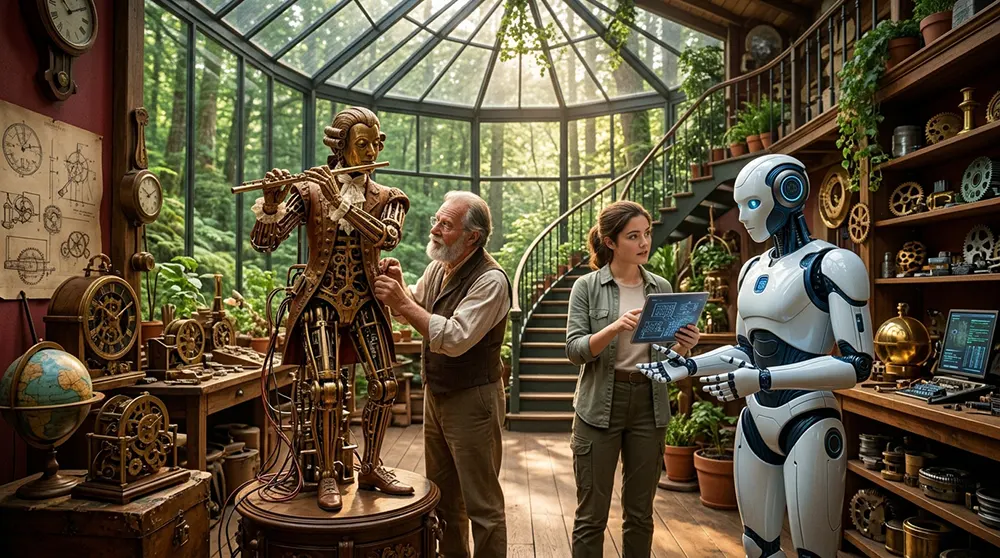
Automata, Automation and Robotics: From Mechanical Origins to Artificial Intelligence
Introduction: From Mechanical Motion to Intelligent Machines
Long before artificial intelligence became a defining technological ambition of the twenty-first century, human ingenuity was already seeking ways to reproduce movement, automate actions and construct machines capable of operating without continuous human intervention. From ancient mechanical devices to contemporary humanoid robots, the history of automata reflects an enduring aspiration: to transfer the execution of tasks from human beings to artificial systems.
Yet the relationship between automata, automation, robotics and artificial intelligence is more complex than a simple progression from primitive mechanisms to intelligent machines. A mechanism that performs a predefined sequence of movements does not necessarily possess intelligence. A factory robot may execute exceptionally precise operations without learning from experience, while an AI-enabled system may interpret its environment, adapt its behaviour and select actions according to changing circumstances.
Understanding this distinction requires examining the historical, mechanical, mathematical and computational foundations of automated systems. It also means recognising that contemporary robotics is not merely an extension of traditional machinery. It increasingly brings together mechanical engineering, electronics, control theory, computer vision, machine learning and advanced decision-making.
This technological convergence is particularly visible in Asia, where companies such as Unitree Robotics, UBTECH Robotics, Estun Automation, Inovance, Yaskawa and FANUC operate across different segments of the robotics and industrial automation landscape.
Their activities illustrate several complementary approaches to the automation of physical work: highly specialised industrial robots, precision motion-control systems, integrated factory automation and humanoid machines designed to interact with environments originally built for human beings.
The central question is therefore not simply how machines have learned to move. It is how mechanical action has progressively become programmable, measurable, controllable and, in certain applications, adaptable through artificial intelligence.
Contents
- 1. What Is an Automaton? Definitions and Fundamental Distinctions
- 2. Ancient Automata: The First Mechanical Experiments
- 3. Al-Jazari and the Sophistication of Medieval Mechanical Engineering
- 4. Renaissance Mechanisms and the Rise of Programmable Movement
- 5. The Industrial Revolution and the Emergence of Automatic Control
- 6. Feedback, Regulation and the Mathematical Foundations of Control
- 7. Automata Theory, Computation and the Concept of a Program
- 8. Automation: Making Processes Operate Automatically
- 9. Robotics: Giving Machines the Ability to Act in the Physical World
- 10. From Conventional Robotics to Embodied Artificial Intelligence
- 11. The Main Components of an Intelligent Robotic System
- 12. Asia’s Robotics Ecosystem: Different Companies, Complementary Technologies
- 13. Unitree Robotics: Legged Robots and Humanoid Machines
- 14. UBTECH Robotics: Humanoid Robots for Industrial Environments
- 15. Estun Automation: Industrial Robotics and Motion Control
- 16. Inovance: The Automation Infrastructure Behind Modern Industry
- 17. Yaskawa and FANUC: Japanese Expertise in Industrial Robotics
- 18. What Makes a Robotic System Intelligent?
- 19. Technical Limitations, Industrial Challenges and Ethical Considerations
- 20. Future Perspectives: Towards More Adaptive and Autonomous Machines
- 21. Conclusion: The Long History of Mechanising Action
- Sources and Further Reading
1. What Is an Automaton? Definitions and Fundamental Distinctions
The word automaton refers to a device capable of carrying out a sequence of actions through an internal mechanism, a predefined programme or a combination of mechanical and electronic controls.
Historically, automata were often mechanical constructions driven by weights, springs, water, compressed air or other energy sources. Modern equivalents may rely on electric motors, electronic controllers, sensors and software.
Despite their technological differences, these systems share a fundamental principle: their operation is organised so that certain actions can occur without requiring a human operator to direct every individual movement.
Several related concepts must nevertheless be distinguished.
1.1. Automaton
An automaton is a system that executes actions according to a defined mechanism or set of rules. Its behaviour may be entirely mechanical, electronically controlled or computationally implemented.
An automaton does not necessarily perceive its environment, learn or make decisions in the sense associated with artificial intelligence. It may simply reproduce a fixed sequence of operations.
1.2. Automation
Automation refers to the organisation of a process so that some or all of its operations can be performed automatically.
It encompasses much more than robotics. An automated production line may use conveyors, sensors, programmable logic controllers, industrial software and mechanical actuators without containing a humanoid robot or any AI-based component.
1.3. Automatic control
Automatic control concerns the regulation of a system’s behaviour through commands and, frequently, feedback from measurements.
A temperature controller, for example, compares the measured temperature with a target value and adjusts heating power accordingly. Its operation can be automatic even if it uses no machine learning.
1.4. Robotics
Robotics combines mechanical structures, actuators, sensors, control systems and software to enable machines to perform physical actions.
Robots may be stationary or mobile, industrial or domestic, autonomous or remotely operated. Some are designed for a single highly repetitive task, while others must operate in environments that are less predictable.
1.5. Artificial intelligence
Artificial intelligence encompasses computational methods designed to perform tasks associated with capabilities such as perception, learning, reasoning, planning and decision-making.
AI can be incorporated into a robot, but the two concepts are not interchangeable. A robot can operate without AI, and an AI system can function entirely in software without controlling a physical machine.
1.6. Embodied artificial intelligence
Embodied AI refers to artificial intelligence operating through, or in relation to, a physical or simulated body that interacts with an environment.
In robotics, this involves connecting perception and decision-making with movement. An embodied AI system must do more than generate an answer: it must translate its decisions into actions that remain physically feasible and safe.
The distinction matters because the automation of a task and the intelligent interpretation of a situation are two different engineering problems. Modern robotic systems increasingly combine both, but neither automatically implies the other.
2. Ancient Automata: The First Mechanical Experiments
The history of automata extends back to ancient civilisations, where mechanical devices were developed for practical, ceremonial, theatrical and scientific purposes.
Ancient engineers explored the use of water, air pressure, gravity, pulleys, levers and rotating components to produce controlled movement. Some devices opened doors, operated fountains, produced sounds or created the impression that an object was moving independently.
These constructions should not be confused with modern intelligent machines. Their importance lies instead in the development of mechanical principles that made repeatable action possible.
2.1. Hero of Alexandria
Hero of Alexandria, a mathematician and engineer who lived during the first century CE, is associated with some of the most important surviving descriptions of ancient mechanical devices.
His treatise on automata describes mechanisms capable of producing movements through carefully arranged mechanical components and energy sources. His wider engineering work also explored pneumatic devices, hydraulic systems and ingenious theatrical mechanisms.
Such constructions demonstrated that a sequence of actions could be produced through the physical organisation of a machine rather than through continuous direct manipulation by a human operator.
A device might use cords, weights, drums, valves or changes in pressure to coordinate its movements. The behaviour resulted from the interaction of its components and the physical laws governing them.
This principle remains central to modern automation: a machine can be designed so that its structure and control mechanism determine how it behaves.
2.2. Theatrical and ceremonial mechanisms
Ancient automata also served to create surprise and spectacle.
Moving figures, mechanical doors and devices producing seemingly spontaneous effects could be used in theatrical performances or religious settings. Their apparent autonomy was a consequence of carefully concealed mechanisms and precisely organised sequences of movement.
These machines reveal an important distinction between actual autonomy and perceived autonomy. An observer may interpret a machine’s behaviour as spontaneous even when every movement has been predetermined by its construction.
The same distinction remains relevant today. A humanoid robot that walks convincingly or responds to a spoken command may appear intelligent, but its outward behaviour alone does not establish how much of its operation depends on fixed programming, learned models or environmental feedback.
2.3. The significance of ancient mechanical engineering
The principal legacy of ancient automata can be summarised in three ideas:
- Repeatability: a mechanism can reproduce an action under sufficiently similar conditions.
- Mechanical coordination: several components can be organised to produce a sequence of related movements.
- Operational independence: once activated, a device can complete certain actions without continuous manual intervention.
These principles established an early technological foundation for later developments in clocks, industrial machinery, programmable mechanisms and robotics.
They did not, however, establish artificial intelligence in the modern computational sense.
3. Al-Jazari and the Sophistication of Medieval Mechanical Engineering
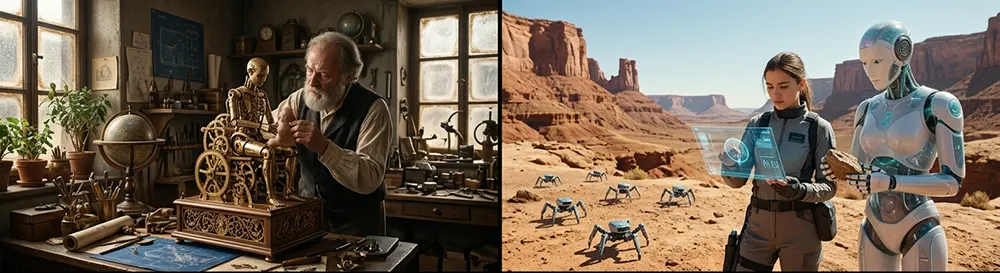
One of the most remarkable figures in the history of mechanical engineering is Ismail al-Jazari, an engineer who worked in the early thirteenth century.
Around 1206, he completed a celebrated treatise describing mechanical devices, including water clocks, automata, fountains, vessels and mechanisms involving moving figures.
His work illustrates how sophisticated mechanical systems could become long before the emergence of modern electronics or digital computation.
3.1. Water clocks and mechanical figures
Al-Jazari’s devices frequently combined the regulation of water flow with mechanical transmission systems.
Water clocks, for example, required a mechanism that could translate the gradual passage of time into a visible or audible sequence of events. Some constructions incorporated moving figures or mechanical musicians, transforming timekeeping into a coordinated performance.
The resulting systems were not simply collections of independent moving parts. Their behaviour depended on the relationship between energy, timing, mechanical transmission and the sequencing of operations.
3.2. Cam mechanisms and the organisation of movement
Cams and related transmission mechanisms are important because they make it possible to transform continuous rotation into a prescribed pattern of movement.
A rotating component can be shaped or arranged so that another component moves according to a particular sequence. By modifying the geometry or arrangement of these parts, an engineer can alter the timing, duration and amplitude of an action.
This principle is closely related to the logic of later mechanical programming.
In a contemporary machine, a software instruction may specify when an actuator should move. In a mechanical system, the shape and arrangement of the components can encode part of the same operational sequence.
The implementation differs, but both approaches organise action according to a predefined structure.
3.3. Why al-Jazari matters to the history of robotics
Al-Jazari’s work is significant for several reasons.
First, it demonstrates the ability of mechanical engineering to coordinate multiple movements within a single device.
Second, it illustrates how timing and transmission can be incorporated into a machine’s physical architecture.
Third, it reveals that the history of automation cannot be reduced to the development of electricity or computers. Many of its fundamental principles emerged from much earlier investigations into mechanics, energy and controlled movement.
Nevertheless, it would be misleading to describe al-Jazari’s devices as artificial intelligence. Their sophistication lay in mechanical design, not in machine learning or computational reasoning.
4. Renaissance Mechanisms and the Rise of Programmable Movement
During the Renaissance and the centuries that followed, European engineers and inventors developed increasingly sophisticated mechanical devices, including elaborate clocks, moving figures and machines designed to imitate human or animal actions.
These constructions were often intended to demonstrate technical virtuosity. They also helped develop the mechanical precision that would later become essential to industrial manufacturing.
4.1. The mechanical imitation of living beings
Automata designed to imitate birds, musicians or human figures occupied a special place in the history of mechanical engineering.
Their movements were generated through combinations of gears, cams, springs, linkages and other components. Although they could reproduce aspects of biological movement, they did not possess the biological systems or cognitive capacities of the beings they imitated.
The distinction between imitation and intelligence is fundamental. Reproducing the outward appearance of an action does not necessarily reproduce the internal processes responsible for that action in a living organism.
4.2. Jacques de Vaucanson
The French engineer Jacques de Vaucanson, who lived from 1709 to 1782, became famous for his elaborate mechanical automata, including a flute player and a mechanical duck.
His constructions attracted attention because they attempted to reproduce complex behaviours through carefully engineered mechanisms.
Vaucanson’s work contributed to a broader tradition of investigating how intricate movements could be decomposed into mechanical operations and then reconstructed through an artificial system.
His activities also intersected with industrial technology, particularly the development and improvement of textile machinery.
4.3. The Jacquard loom and the idea of a programme
The Jacquard loom, introduced in the early nineteenth century, represents a major milestone in the history of programmable machinery.
Its use of punched cards allowed weaving patterns to be specified through a sequence of encoded instructions. The cards controlled which threads were selected during the weaving process.
This was not a computer in the modern electronic sense, but it demonstrated that the behaviour of a machine could be modified by changing an external representation of instructions rather than rebuilding the entire mechanism.
The principle anticipates a central feature of digital computing: separating the instructions that determine a machine’s behaviour from the physical apparatus that executes them.
It is therefore useful to understand the Jacquard loom as an important precursor to programmable systems, while avoiding the simplistic claim that it was equivalent to a modern computer.
5. The Industrial Revolution and the Emergence of Automatic Control
The Industrial Revolution transformed the relationship between machinery, labour and production.
As factories expanded, manufacturers increasingly required machines capable of maintaining consistent operating conditions, repeating complex sequences and producing goods at scale.
Mechanisation initially focused on replacing or amplifying physical effort. Automation progressively extended this transformation by reducing the need for direct human intervention in the execution and regulation of industrial processes.
5.1. From mechanised work to automatic operation
A mechanised machine performs physical work using an external energy source. An automated machine goes further by incorporating mechanisms that regulate at least part of its operation.
For example, a motor may provide the energy needed to move a conveyor. A control system can determine when the conveyor starts and stops, while sensors detect whether an object has reached a particular position.
These elements turn a simple mechanical operation into an organised process.
The distinction is essential because industrial automation depends not only on machinery capable of performing work, but also on the ability to coordinate, sequence and regulate that work.
5.2. The centrifugal governor
The centrifugal governor associated with the development of steam-engine regulation illustrates the importance of feedback.
A governor can respond to changes in rotational speed and adjust the mechanism supplying energy to the engine. When the speed rises or falls, the governor changes its position and influences the engine’s operation.
This makes it possible to regulate a physical process in response to measured behaviour rather than relying exclusively on a fixed command.
The principle is fundamental to control engineering: the system’s actual behaviour influences the commands used to govern it.
5.3. Electrification and industrial control
The development of electrical machinery introduced new possibilities for controlling production equipment.
Electric motors, relays, switches and measurement devices made it easier to coordinate operations across increasingly complex industrial installations.
Later, electronic controllers and programmable logic controllers enabled manufacturers to implement complex sequences in a more flexible form.
The introduction of programmable logic controllers during the twentieth century was particularly important because it allowed industrial control logic to be modified without redesigning all the associated electrical hardware.
Modern factories build on this foundation through networks of controllers, sensors, actuators, industrial computers and supervisory software.
6. Feedback, Regulation and the Mathematical Foundations of Control
Automatic control is one of the essential foundations of modern automation and robotics.
Its central objective is to influence the behaviour of a system so that it achieves a desired outcome despite disturbances, uncertainty or changing operating conditions.
6.1. The basic control loop
A typical control system includes several elements:
- A target or reference value.
- A measurement of the system’s current state.
- A comparison between the target and the measured value.
- A controller that determines the corrective action.
- An actuator that applies the command.
- A physical process whose behaviour can be measured again.
The difference between the target and the measured value is often called the error.
Consider a robot arm that must position a component at a precise location. The controller compares the requested position with the measured position and adjusts the motor commands to reduce the difference.
The process repeats until the system reaches an acceptable state or the controller determines that the task cannot be completed under the current conditions.
6.2. Open-loop and closed-loop control
In an open-loop system, commands are executed without using measurements of the resulting output to correct the behaviour.
A simple timer that activates a motor for a predetermined duration is an example. The motor may run for the specified interval regardless of whether the desired movement has actually occurred.
In a closed-loop system, measurements are used to adjust the operation.
A motor equipped with position feedback can compensate for certain disturbances and differences between the commanded and actual movement.
Closed-loop control is therefore generally more suitable when precision, stability or disturbance rejection is important.
However, feedback does not automatically make a system intelligent. A conventional controller can use sophisticated measurements and mathematical rules without learning or reasoning in the AI sense.

6.3. PID control
Proportional-integral-derivative control, commonly known as PID control, is widely used in industrial automation.
It calculates a control action from the error between the target and the measured state, taking into account the current error, its accumulated history and its rate of change.
PID controllers are used in applications such as temperature regulation, motor control, pressure management and process automation.
Their enduring importance illustrates a crucial point: many industrial tasks are better addressed through well-established control methods than through machine learning.
A system does not need AI merely because it operates automatically or responds to its environment.
6.4. Control theory and artificial intelligence
Control theory and AI address overlapping but distinct problems.
Control theory provides methods for regulating dynamic systems, maintaining stability and achieving desired physical behaviour.
AI methods can help interpret complex observations, recognise patterns, predict outcomes or select actions in situations where explicitly programmed rules are insufficient.
In advanced robotics, the two approaches can be combined. An AI model may identify an object or propose a sequence of actions, while conventional control systems ensure that the resulting movements remain stable and physically feasible.
This combination is often more practical than attempting to replace the entire control architecture with a single AI model.
7. Automata Theory, Computation and the Concept of a Program
The word automaton also has a precise meaning in theoretical computer science.
An abstract automaton is a mathematical model of a system that changes state in response to inputs according to defined transition rules.
This concept helps explain how mechanical sequences, electronic circuits and software-based processes can be represented within a common framework.
7.1. States, inputs and transitions
A finite-state machine consists of a set of possible states, a set of inputs and rules determining how the system moves from one state to another.
A simplified industrial machine might have the following states:
- Idle.
- Waiting for an object.
- Processing.
- Completing the operation.
- Reporting an error.
When a sensor detects an object, the system may transition from the waiting state to the processing state. Once the operation is complete, it may return to idle.
This formal representation helps engineers design predictable systems, verify operating sequences and identify conditions that could cause failures.
7.2. Deterministic behaviour
A deterministic automaton produces the same transition for the same state and input, assuming its rules and relevant conditions remain unchanged.
This property is valuable in industrial environments, where traceability, repeatability and predictable behaviour are often essential.
AI systems, by contrast, may use probabilistic models or learned policies whose outputs depend on complex statistical relationships. Even then, the surrounding software and control architecture can be designed to enforce deterministic safety constraints.
The distinction is not absolute: AI systems can operate within deterministic workflows, and conventional automata can be embedded in larger systems that handle uncertainty.
7.3. From mechanical instructions to software
The historical transition from mechanical sequencing to digital programming did not eliminate the principles of automata. It provided new ways to represent and execute them.
A cam can encode a sequence mechanically. A punched-card system can encode a pattern through physical perforations. A programmable controller can encode transitions through logical instructions. A computer can represent more elaborate processes in software.
Each approach provides a different way of organising behaviour.
Modern AI extends this landscape by introducing systems that can derive patterns or action strategies from data rather than relying exclusively on rules written in advance.
Nevertheless, learned behaviour still requires computational infrastructure, execution mechanisms and constraints appropriate to the task.
8. Automation: Making Processes Operate Automatically
Automation is broader than the use of robots. It includes any technical arrangement that allows processes to execute with reduced direct human intervention.
Its applications range from household temperature regulation to chemical processing plants, logistics networks, digital services and complex manufacturing facilities.
8.1. Fixed automation
Fixed automation is designed around a relatively stable task or production sequence.
It is particularly suitable when large quantities of identical or similar products must be manufactured efficiently.
Its advantages include high throughput, consistency and predictable operation. Its principal limitation is that changing the process may require substantial modifications to the equipment.
8.2. Programmable automation
Programmable automation allows the operating sequence to be modified through software or configuration changes.
Industrial machines can therefore be adapted to different products, operating conditions or production requirements without replacing the entire installation.
Programmable logic controllers are a central example. They can coordinate sensors, motors, valves, conveyors and safety devices according to defined control logic.
8.3. Flexible automation
Flexible automation aims to accommodate changes in products, production sequences or operating conditions with limited interruption.
It can involve programmable robots, machine vision, reconfigurable equipment and integrated production-management systems.
Flexibility does not necessarily require AI. A well-designed programmable system may handle a broad range of known variations without learning from new data.
8.4. Intelligent automation
Intelligent automation combines conventional automation with capabilities such as machine learning, computer vision, language processing or predictive analytics.
These capabilities may be useful when a process involves variable inputs, complex recognition tasks or decisions that cannot be handled efficiently through fixed rules alone.
For example, a vision system may identify irregularly positioned objects on a conveyor, while an industrial robot uses that information to determine where to grasp them.
The practical value of intelligent automation depends on whether the additional capabilities improve measurable outcomes enough to justify their cost, complexity and operational risks.
9. Robotics: Giving Machines the Ability to Act in the Physical World
Robotics brings together the physical and computational elements needed to perform actions in an environment.
A robot must have some means of generating movement, controlling its position or orientation, and executing a task. Depending on its design, it may also need to perceive objects, navigate obstacles or interact with people.
9.1. Industrial robotic arms
Industrial robotic arms are widely used for tasks such as welding, painting, assembly, material handling and machine tending.
Their articulated joints allow them to position tools or objects within a defined working space.
Many industrial robots are designed for exceptional repeatability, speed and reliability. They may operate inside tightly controlled production cells, where the environment and the task are specified in advance.
These robots do not need to resemble humans. A specialised arm may be much more effective than a humanoid robot for a task involving repeated movements along known trajectories.
9.2. Mobile robots
Mobile robots move through an environment rather than remaining fixed in one position.
Autonomous mobile robots can transport materials within factories, warehouses and distribution centres. Depending on their design, they may use cameras, laser scanners, inertial sensors, maps and other positioning technologies.
Their autonomy varies considerably. Some follow predefined routes, while others dynamically plan paths around obstacles.
9.3. Quadruped robots
Quadruped robots use four legs to move across surfaces that may be difficult for wheeled platforms.
They can be used for inspection, mapping, research and operations in environments where conventional vehicles are less suitable.
Their locomotion requires coordination between mechanical structures, actuators, sensors and control algorithms. More advanced systems can adapt their movements to changing terrain or disturbances.
However, the ability to walk over uneven ground does not by itself imply general intelligence. Locomotion is a demanding engineering capability in its own right.
9.4. Humanoid robots
Humanoid robots are designed with a body structure that broadly resembles the human form, often including a torso, arms, legs and a head-like sensor assembly.
Their potential advantage is compatibility with environments designed for human beings. Doors, stairs, workstations and many tools are built around human dimensions and movement patterns.
Yet the humanoid form also creates substantial engineering challenges. Balancing, walking, manipulating objects, maintaining stability and managing energy consumption are difficult problems even before advanced reasoning is introduced.
Humanoid robotics is therefore not simply a matter of adding an AI model to a human-shaped machine. It requires the integration of mechanics, sensing, control, computation and task-specific intelligence.

10. From Conventional Robotics to Embodied Artificial Intelligence
Traditional robots often operate according to predefined programmes. They can be extremely capable within the situations for which they were designed, but their behaviour may become unreliable when the environment changes beyond the conditions anticipated by their developers.
Embodied AI seeks to improve a system’s ability to interpret and act within its environment by integrating learned models with physical interaction.
10.1. Perception
A robot may need to recognise objects, estimate distances, identify surfaces, detect people or interpret the position of its own body.
Computer vision and other perception methods transform raw sensor data into information that can guide action.
A camera does not automatically provide a complete understanding of a scene. The system must interpret the visual information and account for uncertainty, occlusion, lighting conditions and changes in perspective.
10.2. Planning and decision-making
Planning involves selecting a sequence of actions that can achieve a goal under particular constraints.
For example, a mobile robot may need to reach a destination while avoiding obstacles, conserving energy and respecting restricted areas.
A manipulation system may need to determine which object to grasp, how to approach it and how to place it without damaging the object or surrounding equipment.
These problems may combine conventional algorithms, geometric reasoning, learned models and feedback from the environment.
10.3. Machine learning and reinforcement learning
Machine learning allows a system to derive patterns from data rather than relying entirely on manually specified rules.
Reinforcement learning is a family of methods in which an agent learns a policy through interaction with an environment or through simulated experience, using a reward signal to evaluate outcomes.
These methods can be useful for complex tasks such as locomotion and manipulation. However, their successful application depends on the quality of training, the design of the learning objective and the ability to transfer learned behaviour to real-world conditions.
10.4. Vision-language-action models
Vision-language-action models seek to connect visual observations and language-based instructions with actions.
A system might receive a request to identify an object, pick it up and place it in a designated location. A model can help interpret the instruction and connect it to relevant observations and candidate actions.
However, such a model should not be treated as an infallible controller. The physical execution of its proposed actions must be supported by appropriate motion planning, low-level control, monitoring and safety mechanisms.
10.5. Simulation and the sim-to-real problem
Simulation allows robots and learning systems to be trained or tested in virtual environments before deployment.
It can reduce the cost of experimentation and provide access to a wider range of scenarios than might be practical in a physical laboratory.
Nevertheless, simulated environments do not reproduce every feature of reality. Friction, deformation, sensor noise, unexpected collisions and mechanical wear can produce differences between simulated and actual behaviour.
The transfer from simulation to physical operation is commonly described as the sim-to-real problem.
Robust robotic systems must therefore be tested under realistic conditions, with careful attention to the differences between training environments and actual deployment.
11. The Main Components of an Intelligent Robotic System
An advanced robotic system is not a single technology. It is an architecture composed of interacting hardware and software components.
11.1. Mechanical structure
The mechanical structure determines the robot’s geometry, range of movement, load capacity, stability and physical constraints.
Its design influences what the robot can do, how accurately it can perform a task and how much energy it requires.
11.2. Actuators
Actuators transform energy into movement or force.
Electric motors, hydraulic systems and pneumatic mechanisms are among the technologies used in robotics. Their suitability depends on requirements such as precision, speed, torque, weight, efficiency and environmental conditions.
The performance of an AI model cannot compensate for an actuator that lacks the necessary physical capability.
11.3. Sensors
Sensors provide measurements of the robot’s internal state or surrounding environment.
They may include cameras, encoders, inertial measurement units, force sensors, tactile sensors and laser-based distance sensors.
The system’s understanding of the environment depends partly on the quality, reliability and interpretation of these measurements.
11.4. Control electronics and computation
Controllers process measurements and generate commands for actuators.
Some functions require extremely fast and predictable execution, particularly those responsible for balancing, motor regulation and collision prevention.
These functions are often implemented through dedicated controllers or real-time computing architectures rather than being left entirely to a high-level AI model.
11.5. AI models and task planning
AI models can contribute to object recognition, scene interpretation, language understanding, action selection and adaptation to changing circumstances.
Their role must be clearly defined within the overall architecture. A model that interprets an instruction should not automatically be assumed to provide the low-level control required to execute it safely.
11.6. Safety and supervision
Safety mechanisms may include emergency stops, protective zones, speed limits, collision detection, operational interlocks and monitoring systems.
The precise design depends on the robot, its environment and the applicable standards.
In industrial applications, safety cannot be reduced to a model’s confidence score or a statement that the system has been trained on a large dataset. It requires engineering controls, validation and procedures appropriate to the hazards involved.
12. Asia’s Robotics Ecosystem: Different Companies, Complementary Technologies
Asia has become a major centre of robotics and industrial automation, supported by extensive manufacturing capabilities, electronics supply chains, engineering expertise and substantial domestic markets.
China and Japan are particularly important, although their industrial structures and company specialisations differ.
Some manufacturers focus on humanoid or quadruped robots designed to demonstrate increasingly sophisticated physical capabilities. Others concentrate on industrial robotic arms, servo systems, motion controllers, programmable automation and the components that allow factories to operate reliably.
These activities are complementary rather than interchangeable.
12.1. China’s expanding robotics sector
China’s robotics ecosystem includes companies working across mechanical engineering, electronic components, industrial control, AI software and complete robotic platforms.
The breadth of this ecosystem can support rapid product development and integration between hardware and software.
At the same time, the visibility of a new robot or a successful demonstration should not be confused with proof of large-scale commercial viability. A system’s long-term value depends on reliability, maintenance requirements, task performance and the economics of deployment.
12.2. Japan’s industrial robotics tradition
Japan has developed a substantial industrial robotics sector, with companies serving manufacturing, automotive production, electronics, material handling and other industrial applications.
Japanese manufacturers such as Yaskawa and FANUC have long been associated with industrial robots, motion control and factory automation.
Their importance illustrates that robotics is not limited to humanoid platforms. Precision, repeatability, uptime and integration into industrial production remain central to the economic value of robotic systems.
12.3. Why the distinction matters
Comparing robotics companies requires examining what they actually sell and where their technologies are deployed.
A company specialising in legged robots operates in a different competitive environment from a manufacturer of servo drives or industrial robot arms.
Likewise, a company supplying control components may influence a much larger number of automated installations than a manufacturer whose most visible products are humanoid robots.
The relevant questions concern the technologies provided, the markets served, the maturity of the products and the evidence of operational performance.
13. Unitree Robotics: Legged Robots and Humanoid Machines
Unitree Robotics is a Chinese robotics company known for its work on quadruped robots and humanoid platforms.
Its activities encompass robotic hardware and technologies associated with locomotion, perception and motion control. These areas are important to the development of machines capable of moving through environments that are more complex than a conventional factory production cell.

13.1. The challenge of legged locomotion
A legged robot must maintain stability while its centre of mass moves and its feet repeatedly change contact with the ground.
Walking, running and recovering from disturbances require coordinated control of multiple joints and continuous interpretation of the robot’s state.
Uneven terrain introduces additional uncertainty. The robot must account for changes in surface height, friction and contact conditions.
These requirements make legged robotics a demanding combination of mechanical design, control theory and real-time computation.
13.2. From quadrupeds to humanoids
Humanoid robots introduce further challenges because their body structure and movement patterns are more complex.
A bipedal robot must maintain balance on two legs while potentially carrying objects or moving its arms. Manipulation adds another layer of complexity because forces applied by the hands can affect the stability of the entire body.
The development of such platforms is therefore an important engineering undertaking, but successful demonstrations do not establish that every intended application is already commercially practical.
13.3. Commercialisation and market expectations
Unitree’s trajectory also illustrates the relationship between technological progress and financial expectations.
In 2026, the company’s public-market debut attracted substantial attention, with reporting describing pronounced share-price volatility. Such movements illustrate how investors may react to expectations surrounding humanoid robotics even while the industry’s long-term commercial prospects remain uncertain.
Financial market performance should not be treated as a direct measure of a robot’s technical capabilities or the profitability of its deployment.
A rigorous assessment must distinguish between product demonstrations, actual customer deployments, recurring sales, operating costs and sustainable demand.
For further information, consult Unitree Robotics’ official website.
14. UBTECH Robotics: Humanoid Robots for Industrial Environments
UBTECH Robotics is a Chinese robotics company known for its humanoid robot development and its work on robotic systems intended for industrial and commercial applications.
Its activities include humanoid platforms such as the Walker series, alongside technologies intended to support perception, movement and coordinated robotic operations.
14.1. Humanoid robots in factories and logistics
Humanoid robots attract interest partly because industrial environments already contain workstations, shelves, doors and tools designed around human dimensions.
In principle, a robot with a human-like body could perform several different tasks without requiring every workplace to be redesigned around a specialised machine.
In practice, this flexibility depends on the robot’s ability to perform the relevant tasks reliably, safely and economically.
Walking through a factory is only one part of the problem. A commercially useful system may also need to identify objects, manipulate them accurately, cope with unexpected situations and operate over extended periods.
14.2. Coordinated robotic operations
Industrial deployment can involve multiple robots working within a shared environment.
Coordinating such systems requires task allocation, communications, scheduling, monitoring and procedures for handling failures or unexpected events.
AI may help interpret tasks and adapt to variations, while conventional industrial control systems remain essential for reliable execution.
The integration of humanoid robots into existing operations is therefore as much an organisational and systems-engineering challenge as a question of individual robot capability.
14.3. Deployment versus demonstration
Reports of humanoid robots entering industrial environments are significant, but the nature of each deployment matters.
A pilot project, a limited production trial and a mature operation running continuously at scale are different stages of commercial development.
To evaluate progress, it is necessary to examine the number of systems deployed, the tasks performed, the amount of human supervision required, operational reliability and the economic benefits achieved.
These criteria provide a more meaningful basis for comparison than promotional videos alone.
More information is available through UBTECH Robotics’ official company profile.
15. Estun Automation: Industrial Robotics and Motion Control
Estun Automation is a Chinese industrial automation and robotics company whose activities include industrial robots and related automation technologies.
Unlike companies primarily associated with humanoid platforms, Estun operates within the broader industrial ecosystem that supports manufacturing processes, robotic manipulation and controlled movement.
15.1. Industrial robots and manufacturing
Industrial robots are commonly used for welding, material handling, assembly, painting and other repetitive or physically demanding operations.
Their value often lies in their ability to maintain consistent performance over repeated cycles while operating within carefully engineered production environments.
The effectiveness of an industrial robot depends on more than its mechanical reach or maximum speed. Factors such as repeatability, payload, cycle time, reliability and ease of integration influence its suitability for a particular task.
15.2. Motion control as a core technology
Motion control governs how mechanical systems move from one position or operating state to another.
It involves coordinating motors, drives, sensors and controllers so that movement follows the required trajectory and responds appropriately to disturbances.
In industrial robotics, motion control is fundamental to positioning tools, manipulating components and coordinating multiple axes.
These technologies may receive less public attention than humanoid robots, but they are essential to the operation of automated production systems.
15.3. Industrial competitiveness
The industrial robotics market depends on the ability to deliver reliable equipment, provide technical support and integrate products into manufacturing environments.
Companies must compete not only on purchase price but also on productivity, maintenance, software compatibility and the availability of replacement parts.
For manufacturers, the total cost of ownership is often more important than the initial price of a robotic arm.
Further information is available on Estun’s official website.
16. Inovance: The Automation Infrastructure Behind Modern Industry
Inovance is associated with industrial automation technologies including drives, servo systems, controllers and motion-control solutions.
Its position illustrates an important feature of the robotics industry: many of the technologies required to build and operate robots are supplied by companies that do not necessarily manufacture complete humanoid machines.

16.1. Drives and servo systems
Drives regulate the electrical power supplied to motors, while servo systems combine control, feedback and actuation to achieve precise movement.
These technologies are used in manufacturing equipment, automated production lines, packaging machinery and robotic applications.
Their performance can influence positioning accuracy, responsiveness, energy consumption and the ability to coordinate several mechanical axes.
16.2. Controllers and industrial integration
Industrial controllers coordinate machines and production processes according to defined logic.
They may interact with sensors, motors, human-machine interfaces and supervisory software to ensure that equipment performs the correct operations in the correct order.
Integrating these components into a reliable automation system requires attention to communications, timing, diagnostics and safety.
16.3. The less visible foundations of robotics
The development of increasingly sophisticated robots depends on advances in motors, sensors, power electronics, control systems and manufacturing processes.
These components are often less visually striking than a robot walking or manipulating an object, yet they determine much of the system’s real-world performance.
The wider industrial automation ecosystem is therefore essential to understanding how robotics can move from research laboratories to commercially viable applications.
More information can be found on Inovance’s official website.
17. Yaskawa and FANUC: Japanese Expertise in Industrial Robotics
Japan has a long-standing presence in industrial robotics, and Yaskawa and FANUC are two important companies within this sector.
Their activities illustrate the importance of specialised industrial equipment, reliable control technologies and the integration of robotics into manufacturing processes.
17.1. Yaskawa
Yaskawa is associated with industrial robotics, servo drives and motion-control technologies.
These fields are closely connected. An industrial robot requires mechanical joints, motors, control electronics and software capable of coordinating movement with the precision demanded by the task.
In manufacturing, this integration supports applications such as material handling, welding and other automated operations.
Yaskawa’s wider automation activities demonstrate how robotics depends on a combination of mechanical and electronic engineering rather than on AI alone.
Official information is available from Yaskawa.
17.2. FANUC
FANUC is known for industrial robots, computer numerical control systems and factory automation technologies.
Computer numerical control, or CNC, allows machine tools to execute operations according to programmed instructions. Industrial robots extend automation into tasks involving movement, handling and interaction with equipment.
When these technologies are integrated into a production environment, they can contribute to coordinated manufacturing processes with consistent operating procedures.
FANUC’s activities also illustrate why industrial robotics must be evaluated in terms of production performance, reliability and integration, rather than solely through the sophistication of a robot’s appearance.
Further information is available from FANUC.
17.3. Industrial robots and humanoid platforms are not direct substitutes
A conventional industrial arm, a CNC machine and a humanoid robot are designed around different requirements.
A fixed robotic arm can be optimised for a specific working envelope and repetitive task. A CNC machine is designed to perform controlled machining operations. A humanoid platform aims to combine locomotion and manipulation within a body structure that can operate in human-oriented environments.
The appropriate solution depends on the task.
For many manufacturing operations, a specialised robot remains more practical than a humanoid system. Humanoid robots may become useful where flexibility across multiple tasks offers sufficient value to offset their greater mechanical and control complexity.
The long-term evolution of robotics is therefore likely to involve several architectures rather than the universal replacement of specialised machines by humanoids.
18. What Makes a Robotic System Intelligent?
The term intelligent robot is used broadly, sometimes obscuring important technical distinctions.
A robot can execute sophisticated movements without AI. It can also incorporate AI for a narrowly defined task without possessing general-purpose intelligence.
A more rigorous assessment examines what the system can perceive, how it selects actions and whether it can adapt to circumstances that were not explicitly anticipated.
18.1. Preprogrammed behaviour
A preprogrammed robot follows a sequence of instructions.
This approach can be extremely effective in a stable environment where the task is well understood and variations are limited.
Its principal weakness is that unexpected conditions may cause the programme to fail or require human intervention.
18.2. Reactive behaviour
A reactive system changes its actions in response to sensor measurements.
For example, a mobile robot may stop when an obstacle is detected or adjust its movement when its position changes.
Such behaviour can be implemented through conventional control rules. Responsiveness alone does not establish the presence of AI.
18.3. Adaptive behaviour
An adaptive system modifies its behaviour in response to changing conditions or information.
Adaptation may involve adjusting controller parameters, selecting among predefined strategies or updating a learned model.
The nature and extent of adaptation must be specified. A system that compensates for a predictable disturbance is not necessarily learning in the same sense as a machine-learning model trained on data.
18.4. Learning-based behaviour
A learning-based robot uses models or policies derived from data, simulation or interaction.
Such systems can potentially handle variations that would be difficult to enumerate through conventional programming.
However, their performance depends on training data, the range of conditions encountered during development and the robustness of the resulting model.
A learned policy that performs well in a laboratory may fail when confronted with unfamiliar objects, unexpected lighting or different physical conditions.

18.5. Autonomy is not a single property
Autonomy exists along a spectrum.
A machine may perform a single operation without supervision but require human assistance when something unexpected occurs. Another system may navigate independently while remaining dependent on human approval for consequential decisions.
A useful evaluation therefore asks:
- Which tasks can the system perform independently?
- Under what environmental conditions does it remain reliable?
- When does it request human assistance?
- How does it detect and recover from failures?
- Which decisions remain under human control?
These questions provide a more precise account of robotic autonomy than a general claim that a machine is intelligent.
19. Technical Limitations, Industrial Challenges and Ethical Considerations
Despite significant progress, robotic systems face substantial technical and economic constraints.
The challenge is not simply to produce a machine that can perform a task once. It is to produce a system that can perform it consistently, safely and economically under real operating conditions.
19.1. Reliability and robustness
Industrial environments contain disturbances that may not be fully represented in laboratory tests.
Objects can be misplaced, sensors can become obstructed, components can wear out and communications can fail.
A robot must be able to operate within defined limits and respond appropriately when those limits are exceeded.
Reliability is particularly important where a failure can interrupt an entire production line or create a safety hazard.
19.2. Energy consumption and battery life
Mobile and humanoid robots require energy for movement, computation and sensing.
Walking, maintaining balance and manipulating loads can consume substantial power. Battery capacity, charging time, thermal management and operating duration therefore influence their practical usefulness.
A robot that performs impressively for a short demonstration may still be unsuitable for an application requiring continuous operation over an entire shift.
19.3. Dexterity and physical interaction
Manipulating unfamiliar objects remains a demanding problem.
A robot may need to estimate an object’s shape, position, weight, friction and fragility before selecting an appropriate grasp.
Human hands possess remarkable dexterity and sensory capabilities. Reproducing comparable performance through artificial mechanisms requires sophisticated hardware, perception and control.
19.4. Economic viability
The commercial value of a robot depends on more than its purchase price.
A realistic assessment should include:
- Initial acquisition and integration costs.
- Installation and workplace modifications.
- Energy consumption.
- Maintenance and replacement parts.
- Software licensing and updates.
- Downtime and operational supervision.
- Training and workforce adaptation.
- Safety measures and regulatory compliance.
The relevant comparison is often the total cost per successfully completed task, rather than the cost of the machine alone.
19.5. Cybersecurity and operational resilience
Connected robotic systems may depend on industrial networks, remote monitoring, software updates and external services.
These connections can improve diagnostics and coordination, but they also create potential attack surfaces.
Security measures should account for authentication, access control, software integrity, network segmentation and recovery procedures.
A robotic system must also remain safe when communications or external computing services become unavailable.
19.6. Employment and the organisation of work
Automation can replace certain tasks, transform existing occupations and create demand for new technical skills.
The consequences vary according to the industry, the tasks involved and the way organisations implement the technology.
A robot may eliminate repetitive physical work while increasing the need for maintenance, programming, process supervision and quality control.
The effects cannot be reduced to a single universal prediction about employment. They depend on investment decisions, productivity gains, worker training and the distribution of economic benefits.
19.7. Accountability and human oversight
When an AI-enabled robot makes an incorrect decision, responsibility may involve several parties: the manufacturer, the software developer, the system integrator and the organisation operating the machine.
Clear procedures are needed to establish responsibility, monitor performance and respond to incidents.
Human oversight is particularly important in environments where mistakes could cause injury, damage equipment or affect vulnerable individuals.
The objective is not to eliminate all automation, but to ensure that its deployment is appropriate to the risks and that its behaviour can be evaluated and controlled.
20. Future Perspectives: Towards More Adaptive and Autonomous Machines
The future of automation is unlikely to be determined by a single breakthrough or a single category of robot.
Progress will depend on the convergence of mechanical engineering, electronics, AI, control systems, manufacturing processes and the economics of deployment.
20.1. The integration of AI with conventional control
One promising direction is the combination of high-level AI with reliable low-level control.
An AI model can interpret an instruction, recognise an object or propose a sequence of actions. A conventional controller can then execute the movement while enforcing limits on speed, force, position and stability.
This division of responsibilities allows systems to benefit from learned capabilities without abandoning the predictability required for physical operation.
20.2. More capable perception and manipulation
Improvements in computer vision, tactile sensing and learned manipulation policies may allow robots to handle a wider variety of objects and situations.
Such progress could be valuable in warehouses, manufacturing facilities, laboratories and other environments where tasks vary but remain sufficiently structured for engineering constraints to be established.
However, improved perception does not automatically solve the problem of reliable physical interaction. The robot must still translate its observations into appropriate movements under real-world conditions.
20.3. Digital twins and simulation
Digital twins and simulation environments can help organisations model production processes, test changes and evaluate robotic behaviour before modifying physical equipment.
When appropriately calibrated, these tools can improve planning and reduce the cost of experimentation.
Their usefulness nevertheless depends on the accuracy of the models, the quality of the data and the degree to which simulated conditions represent the real environment.
20.4. Multi-robot systems
Future factories and logistics networks may increasingly coordinate fleets of robots rather than relying on isolated machines.
This approach can distribute tasks across several systems, improve throughput and provide alternative ways to complete operations when individual robots become unavailable.
Coordination introduces its own challenges, including scheduling, communications, collision avoidance, task allocation and fault recovery.
20.5. The continuing role of specialised robots
Humanoid robots attract attention because they offer a visually compelling vision of general-purpose automation.
Yet specialised robots will remain important wherever a task can be performed more efficiently through a purpose-built design.
The most useful architecture depends on the required movements, operating environment, production volume, safety constraints and expected return on investment.
The future may therefore involve humanoid robots working alongside conventional industrial arms, mobile platforms, machine tools and automated handling systems.
20.6. From impressive demonstrations to measurable results
As robotics develops, the distinction between technological demonstration and commercial deployment will become increasingly important.
A credible assessment should consider:
- The number of tasks performed successfully.
- The duration and continuity of operation.
- The frequency of human intervention.
- The rate of failures and recovery.
- The cost of maintenance and integration.
- The measurable improvement in productivity or quality.
- The safety of workers and the surrounding environment.
These criteria provide a more robust basis for judging technological progress than the apparent sophistication of a machine or the visibility of a product launch.
21. Conclusion: The Long History of Mechanising Action
The history of automata reveals a continuous effort to organise movement, reproduce actions and reduce the need for direct human intervention.
Ancient engineers explored the mechanical coordination of components. Medieval inventors developed increasingly sophisticated systems of transmission and timing. Renaissance automata demonstrated how intricate movements could be reproduced artificially. Industrial machinery introduced new forms of mechanisation and automatic regulation, while control theory and computing established mathematical and digital foundations for modern automation.
Robotics brought these developments into machines capable of acting within the physical world. Artificial intelligence now adds new possibilities for interpreting complex environments, learning from data and selecting actions under conditions that cannot always be described through fixed rules.
Yet these developments should not be understood as a simple replacement of old technologies by new ones.
Mechanical engineering remains indispensable. Sensors and actuators remain essential. Control theory continues to provide the foundations for stable movement. Conventional automation remains highly effective for many industrial tasks, while AI is most valuable where its additional capabilities address a genuine operational challenge.
Companies such as Unitree Robotics and UBTECH Robotics illustrate the growing interest in legged and humanoid platforms. Estun Automation and Inovance demonstrate the importance of industrial robotics and motion-control infrastructure. Yaskawa and FANUC represent the continuing significance of specialised industrial automation and established robotic technologies.
Their activities reflect different parts of the same technological landscape.
The decisive measure of progress will not be whether machines appear increasingly human, but whether they can perform useful tasks reliably, safely and economically. The most successful systems will be those that combine appropriate mechanical design, robust control, effective perception and carefully validated intelligence.
From ancient automata to embodied AI, the central ambition remains recognisable: to build systems that transform instructions, energy and information into coordinated action. What has changed is the complexity of the environments in which those systems can operate, and the extent to which their behaviour can be adapted to circumstances that their designers cannot fully anticipate in advance.
Sources and Further Reading
The following resources provide historical, technical and corporate background for the topics discussed in this article.
Historical automata and mechanical engineering
- University of Glasgow — Research on Hero of Alexandria and ancient automata
- Smithsonian National Museum of Asian Art — Al-Jazari and mechanical devices
- Persée — Historical research on the origins and development of robotics
Artificial intelligence and technical concepts
Robotics and industrial automation companies
- Unitree Robotics — Official website
- UBTECH Robotics — Company profile
- UBTECH Robotics — Official news and developments
- Estun Automation — Company information
- Inovance — Official company website
- Yaskawa — Official website
- FANUC — Official website
Editorial note
Corporate descriptions should be checked against manufacturers’ latest documentation. Product availability, deployment figures, financial performance and the commercial maturity of emerging humanoid robots can change rapidly. Historical interpretations should also be distinguished from contemporary engineering terminology: ancient and medieval automata were sophisticated mechanical systems, but they did not possess artificial intelligence in the modern computational sense.
Cet article est rédigé par Blaise Grenier, Journaliste reporter d'images et auteur. Découvrir le parcours de l'auteur et la charte éditoriale »