Digital Sovereignty and On-Device Inference: A Deep Dive into Local LLMs
Generative artificial intelligence has evolved from a mere academic curiosity into a structural component of modern IT infrastructure. While the general public delegates its queries to remote cloud computing platforms via recurring subscriptions, a growing cohort of demanding users and engineering professionals is exploring a radical alternative: hosting and running Large Language Models (LLMs) directly on their own hardware. Far from being a simple technical gimmick, this approach reshapes the user’s relationship with their machine, transforming them from mere tenants of cloud services into sovereign owners of their compute stack.
Technical Foundations: From Probability to Inference
To fully grasp the deployment of a local AI environment, one must first deconstruct the myth of a thinking machine. An LLM does not “understand” text in the human sense; it is a deep learning system driven by massive probabilistic calculations.
The Model and Its Parameters
The parameter count—denoted by standard nomenclature (8B, 70B, etc.)—represents the synthetic equivalent of biological synapses. These weight matrices, fine-tuned during pre-training phases on supercomputer clusters, dictate the model’s responsiveness and reasoning nuance. The larger this volume, the better the artificial neural network manages contextual subtleties—but the heavier its memory footprint becomes.
The Token: The Fundamental Unit of Measurement
Text is never processed as a whole; instead, it is broken down into lexical or syntactic units called tokens. In standard English prose, one thousand tokens represent roughly seven hundred and fifty words. During the inference phase—the critical moment when the hardware generates a real-time output—each produced token requires a complete pass across the model’s parameters through the memory bandwidth. This is precisely why local system performance is measured in tokens per second ($\text{tok/s}$).
Quantization: The Art of Trade-offs
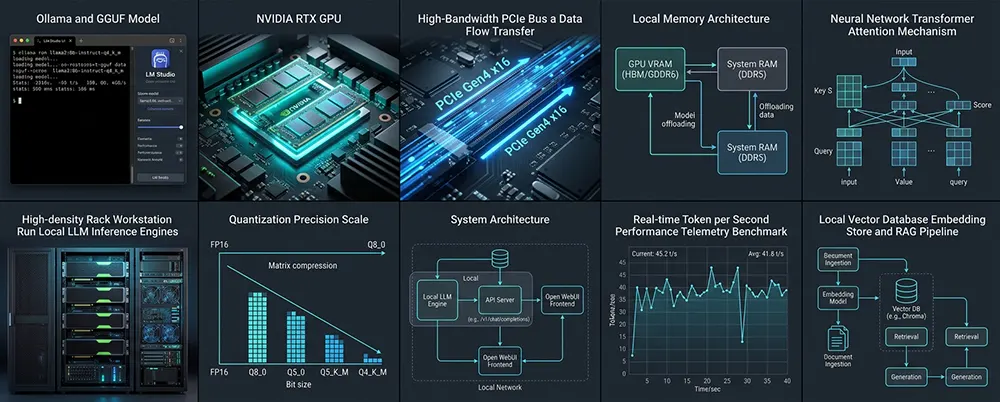
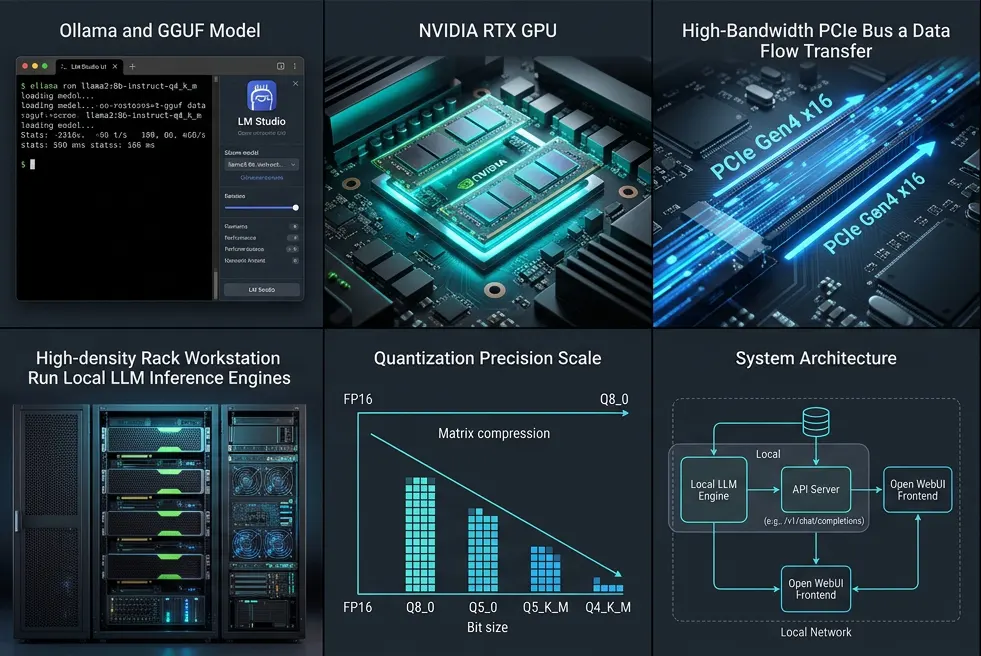
In raw precision (FP16), a large-scale model would demand amounts of VRAM far out of reach for consumer-grade hardware. Quantization resolves this equation by compressing the numerical precision of model weights (for instance, dropping from 16-bit float values down to 4-bit formats like Q4_K_M). This aggressive compression allows formidable models to fit onto standard hardware configurations with an almost imperceptible loss in logical fidelity.
Cloud versus Local: A Strategic Architectural Choice
The divide between cloud-hosted solutions and local inference is not merely a matter of benchmarks; it is a fundamental architectural decision.
| Evaluation Criteria | Proprietary Cloud Ecosystem | Local Inference (Open Weights) |
|---|---|---|
| Data Sovereignty | In transit and stored on third-party servers | Absolute privacy, 100% local processing |
| Availability | Total reliance on network uptime and cloud services | Permanent offline operational autonomy |
| Moderation & Filters | Strict editorial and safety guardrails | Unrestricted freedom, zero arbitrary censorship |
| Economic Model | Recurring subscriptions, API usage fees | Zero marginal cost after hardware setup |
| Raw Capacity | Frontier models (hundreds of billions / trillions) | Bound by host machine VRAM and RAM capacity |
For professionals handling highly sensitive assets—ranging from legal documentation to software reverse-engineering—switching to local execution is not just an option, but a core compliance requirement.
Anatomy of a Benchmark Setup: Hardware Sizing
Empirical evaluation of hardware requirements requires discarding common misconceptions. Unlike traditional 3D graphics workloads, LLM inference places video memory (VRAM) at center stage, relegating the GPU processor itself to a matrix calculation accelerator.
Typology of Tested Configurations
- Entry-Level: Core i5 CPU paired with a GPU featuring adequate memory bus width (a strict minimum of 8 GB VRAM to run lightweight models).
- Specialized Workstations: High-core-count CPUs paired with top-tier GPUs offering high memory bandwidth and large VRAM capacity.
- Unified Architectures: Systems-on-Chip (SoC) combining high volumes of unified memory (128 GB and beyond), allowing users to bypass traditional dedicated VRAM bottlenecks.
The Resource Hierarchy
- VRAM (Video RAM): The absolute bottleneck. If the model weights and its Key-Value context cache (KV Cache) do not fit entirely inside video memory, the execution pipeline must offload layers to system RAM over the PCIe bus, causing inference speed to collapse.
- System RAM & Bandwidth: Crucial for unified memory architectures or CPU offloading modes, though significantly slower than GDDR6 or HBM memory pools.
- NVMe Storage: Primarily leveraged during initial model loading (reading files that often span tens of gigabytes in GGUF format).
Model Taxonomy and Deployment Scenarios
Selecting the right model architecture depends directly on the cognitive complexity of the task at hand. We can delineate three primary operational profiles:
1. The Creative Scenario (Compact models, e.g., Phi-4 Mini, Llama 3.1 8B)
Tailored for smooth text generation, fast translation, or marketing ideation. These responsive models consume minimal hardware resources and deliver exceptional performance on mid-range workstations.
2. The Analyst Scenario (Intermediate models, e.g., Mistral Small, Llama 3.3)
Engineered for dense document synthesis, structured data extraction from technical reports, or batch processing of document corpora. Their extended context windows (often scaled to 32k or 128k tokens) require close monitoring of KV cache memory allocation.
3. The Expert Scenario (Reasoning / Thinking Models)
Inspired by Chain-of-Thought (CoT) frameworks, these specialized models (particularly those fine-tuned for mathematics or code execution) execute an invisible internal reasoning step before outputting a response. While their analytical rigor is outstanding for debugging source code or solving complex equations, this reasoning phase monopolizes compute resources over longer periods.
The Specialized Alternative: Classical NLP vs LLMs
It would be a mistake to reduce Natural Language Processing strictly to generative foundation models. In many enterprise scenarios, deploying traditional NLP architectures remains vastly superior:
- Surgical Precision: Specialized tasks such as Named Entity Recognition (NER) or extracting numerical values from invoices are handled by compact models with superior accuracy and near-zero risk of hallucinations.
- Energy Efficiency: Dedicated NLP models run almost instantaneously on standard CPU threads, eliminating GPU power draw and thermal throttling for straightforward extraction tasks.
Conclusion and Outlook
Reclaiming artificial intelligence through local deployment marks a paradigm shift from centralized cloud dependency toward digital self-reliance. While cloud giants maintain an edge in raw compute power for massive multimodal workloads, the personal workstation is proving itself as an autonomous compute node—giving users complete control over their software stack, execution parameters, and confidential data.
Cet article est rédigé par Blaise Grenier, Journaliste reporter d'images et auteur. Découvrir le parcours de l'auteur et la charte éditoriale »