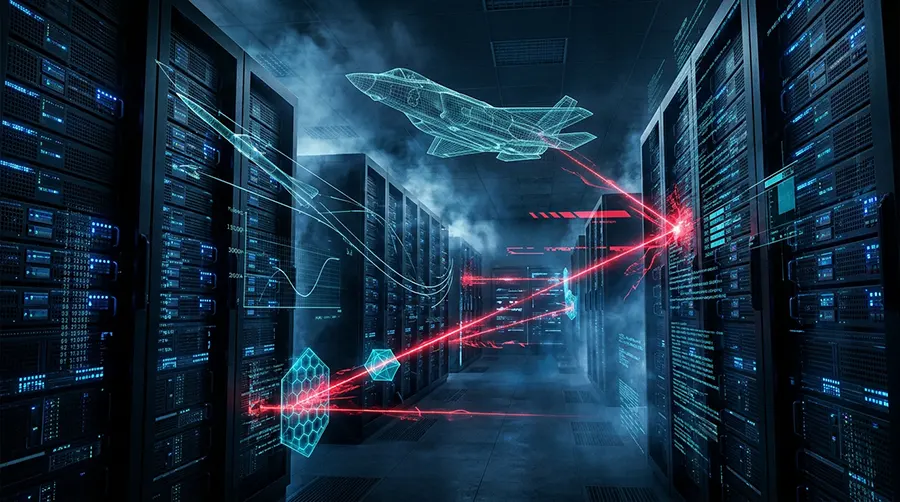
Why are military supercomputers so coveted?
High-performance computing (HPC) plays a strategic role in defense and military AI, exemplified by the Asgard supercomputer at Mont-Valérien. These critical infrastructures remain exposed to cyber espionage, as shown by the November 2026 incident on Japan’s Fugaku supercomputer, where an exposed administration interface affected over 4,500 researchers.
At a time when artificial intelligence and digital simulation are redefining the balance of power, high performance computing (HPC) has established itself as the true backbone of modern warfare. From American nuclear laboratories to Japanese research centers, and including the classified French supercomputer Asgard inaugurated at Mont-Valérien, these giant computers house the most sensitive secrets of states.
Direct consequence: these critical infrastructures have become top targets for state-sponsored cyber espionage groups and cybercriminals. The incident that occurred in November 2026 on the Japanese supercomputer Fugaku (compromised via an exposed administration interface, affecting over 4,500 researchers) serves as a reminder that even the most prestigious machines are not immune.
A top-tier defensive supercomputer doesn’t just perform quick calculations; it forms the central brain of a military’s technological superiority.
- Design of Next-Generation Armaments: Aerodynamic simulation of sixth-generation fighter jets, missile trajectory calculation for hypersonic missiles, radar stealth or modelling of nuclear reactions without actual testing.
- AI Military Training: As highlighted by the Ministry of the Armies in relation to Asgard (equipped with over 1,000 state-of-the-art GPUs), these machines train the AI models embedded in drones, submarines (acoustic detection), and command systems.
- Cryptanalysis and Electronic Warfare: Decryption of intercepted communications and real-time analysis of the electromagnetic spectrum on operational theatres.
The three motivations behind hacking operations
When a group of hackers targets a military or dual-use (civil and defense) computing center, their objectives extend far beyond mere informational paralysis:
- Industrial and military espionage on the cheap: stealing an aircraft engine simulation model or the weights of a defence AI model allows a rival state to save billions of euros and several decades of research and development.
- Compute Hijacking: Rather than destroying the machine, some attackers seek to use it discreetly in the background to train their own offensive AI models, break encryption keys, or mine cryptocurrencies at a speed unattainable on classical servers.
- Silent sabotage (data poisoning): This is the scenario most feared by high command. By subtly altering data sets or simulation parameters, an adversary can skew the design of a weapon system or blind an AI detection system on the battlefield.
The cyber defence challenges posed by complex architectures
Protecting a military supercomputer is a permanent technical challenge, far more complex than securing a traditional enterprise network:
- The paradox of isolation and openness: While the most sensitive machines (like Asgard) are designed to operate completely offline (air-gapped) and are handled only by authorized personnel, many research computing centers must remain accessible remotely to consortia of engineers, academics, and industry professionals. A single vulnerability on a web portal, an administrative tool, or a vendor account can open a breach in the internal network.
- Supply Chain Security: A supercomputer assembles thousands of processors, network chips, and open-source software libraries from multiple suppliers. Verifying that no malicious hardware or software backdoors have been inserted during manufacturing requires extremely rigorous audits.
- The Emergence of Offensive AI: Attackers are now employing their own AI agents capable of scanning millions of lines of code and identifying previously unknown vulnerabilities (zero-day) at superhuman speed, forcing cyber command centers (such as France’s COMCYBER) to automate their own defenses.
Cet article est rédigé par Blaise Grenier, Journaliste reporter d'images et auteur. Découvrir le parcours de l'auteur et la charte éditoriale »