The AI and antibody engineering: how Amazon Bio Discovery redefine drug discovery
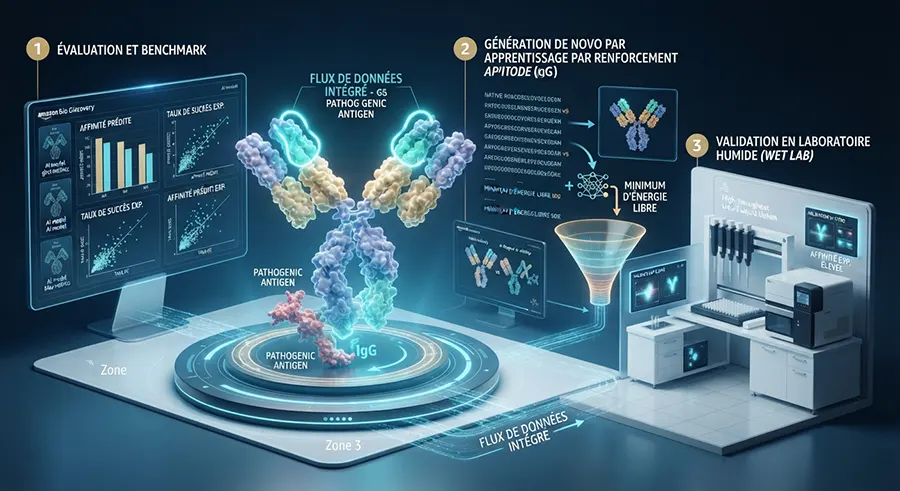
Predictive engineering powered by artificial intelligence accelerates biological drug discovery, as demonstrated by three studies published by Amazon Bio Discovery since 2023. Their protocol combines standardized benchmarking of binding predictors, de novo generation of therapeutic antibodies via reinforcement learning, and experimental wet-lab validation to reduce preclinical timelines and costs.
The discovery of biological medicines is undergoing a silent yet radical transformation. Long confined to laboratory experimental screening—a slow, costly, and largely empirical process—therapeutic antibody design is now shifting into the era of predictive engineering.
At the forefront of this transformation, cloud giants are no longer just providing servers; they are designing algorithms that sketch the molecules of tomorrow. By publishing a series of three major studies on antibody engineering via artificial intelligence, Amazon Bio Discovery unveils a comprehensive methodological roadmap: assess the reliability of predictions, generate novel molecules de novo, and validate their efficacy in real-world labs (wet lab).
1. Overcome the bottlenecks of molecular biology
An antibody is a complex protein whose function relies on a precise mechanism: its recognition site (the paratope) must fit perfectly into a specific region of a pathogenic or tumor target (the epitope).
Until recently, identifying an effective drug candidate was akin to finding a needle in a haystack of biological variants, requiring the immunization of animals or sifting through billions of laboratory variants. Amazon Bio Discovery’s researchers aim to replace this physical exploration with an integrated computational loop, capable of drastically reducing both the preclinical research timeline and costs.
2. The three methodological pillars of Amazon Bio Discovery
To build a reliable end-to-end antibody engineering pipeline, the research teams have broken down the problem into three distinct scientific bottlenecks.
Pillar 1: Rigorous benchmarking of linkage predictors
Before allowing an AI to invent molecules, it is crucial to ensure that it can recognize a good bond from a bad one. Many current predictive models suffer from a major flaw: they achieve excellent scores on known training data but fail when confronted with unseen targets.
- Progress: The first study establishes standardized evaluation protocols (benchmarks) based on extensive experimental data sets.
- Impact: By objectively measuring the forces and dead angles of each algorithm, these benchmarks allow for the elimination of in silico false positives and ensure that only sequences with the highest probability of success are selected for laboratory synthesis.
Pillar 2: Design from scratch through reinforcement learning
The combinatorial space of possible antibody sequences far exceeds comprehension (several dozen billion combinations just on the variable recognition loops). Limiting oneself to slightly modifying existing antibodies considerably limits their therapeutic potential.
- Progress: The second study employs reinforcement learning. Similar to a chess-playing algorithm exploring millions of moves, the AI generates entirely new (de novo) antibody sequences that do not exist in nature. At each iteration, a reward system — guided by binding predictors and biophysical constraints — directs the generation towards optimal structures.
- Impact: Validated in simulated experimental environments, these synthetic designs pave the way for targeting complex epitopes that have so far been inaccessible to conventional therapies.
Pillar 3: The Real-World Test and Laboratory Validation (Wet Lab)
In computational biology, the line between digital success and biological failure is fine: a perfect protein on a screen may fold incorrectly, aggregate, or lose its affinity once synthesized.
- Progress: The third study submits the antibodies generated by AI to the ultimate test of molecular synthesis and real laboratory trials. The results confirm significant gains in affinity and success rates, demonstrating that the models now master complex design cases.
- Persistent Challenges: The study clearly highlights two major bottlenecks before full industrialisation: scalability (the ability to deploy these validations on hundreds of targets simultaneously), and intermolecular dynamics (proteins are flexible entities in constant motion, a parameter that is still difficult to model with absolute precision).
3. Synthesis: The computational antibody value chain
| Pipeline step | Scientific lock resolved | Technology / Key Approach | Research and development gain for pharmaceuticals |
|---|---|---|---|
| 1. Assessment | Algorithm reliability and bias elimination | Benchmarks on massive experimental data | Candidate prioritisation and reduction in screening costs |
| 2. Generation | Exploration of unknown biological space | De novo design through reinforcement learning | Creation of treatments targeting complex epitopes |
| 3. Validation | Transition from the virtual (in silico) to the real (in vitro) | Protein synthesis and biological assays (wet lab) | Clinical proof of efficacy and reduction in late failures |
4. Strategic Analysis: Why is Amazon investing in the biotech sector?
Beyond the scientific feat, the publication of these three studies illustrates a major industrial strategy of the Tech giants (AWS, Google DeepMind with Isomorphic Labs, Microsoft).
Amazon is not intended to become a traditional pharmaceutical laboratory managing phase III clinical trials. Instead, by developing and publishing reference methods based on reinforcement learning and massive molecular simulation, the company shapes the technological standards of modern biotechnology. Moreover, these computational pipelines require colossal computing power — precisely the infrastructure that Amazon Web Services commercializes through its GPU clusters and dedicated services like AWS HealthOmics.
n short, this work marks a turning point: artificial intelligence applied to healthcare is moving beyond the stage of theoretical promise to become a true software factory for designing living systems—reshaping, in the process, the economic balance between pharmaceutical companies and cloud infrastructure providers.
Cet article est rédigé par Blaise Grenier, Journaliste reporter d'images et auteur. Découvrir le parcours de l'auteur et la charte éditoriale »