Who Was Bernhard Riemann, the Visionary Genius Behind This Enigma?
Formulated in 1859 by Bernhard Riemann and carrying a one-million-dollar prize from the Clay Mathematics Institute, the Riemann hypothesis was the subject of a claimed proof on November 20, 2026, by mathematician Levent Alpöge (Anthropic). Developed in collaboration with the AI Claude, the demonstration relies on a 250,000-page archive formally verified in Lean.
Since its formulation in 1859, the Riemann hypothesis has defied the brightest minds on the planet. Listed among the Clay Mathematics Institute’s famed Millennium Prize Problems (each carrying a one-million-dollar reward), this conjecture represents the Holy Grail of number theory. On November 20, 2026, a shockwave rippled through the scientific community: Levent Alpöge, a Princeton- and Harvard-educated mathematician and researcher at Anthropic, announced that he had discovered a proof of this legendary problem in collaboration with Claude, the company’s proprietary artificial intelligence.
Unprecedented at this scale, the proof was not published as a conventional academic paper, but as a vast archive of computer code intended for machine verification.
Before examining this dramatic announcement, it is worth revisiting the extraordinary figure of Georg Friedrich Bernhard Riemann (1826–1866), a solitary mind whose dazzling intuitions reshaped the very architecture of modern mathematics in a career spanning less than fifteen years.
A Meteoric Trajectory Marked by Hardship and Illness
Born on September 17, 1826, in the small village of Breselenz in the Kingdom of Hanover, Bernhard Riemann grew up in a modest, close-knit household as the second of six children raised by a Lutheran pastor who provided his earliest schooling. Deeply introverted—shy almost to the point of paralysis during his earliest public lectures—the young man displayed extraordinary mental calculation skills and a gift for abstraction from an early age, famously absorbing Adrien-Marie Legendre’s massive treatise Number Theory in just six days while attending school in Lüneburg.
Initially slated to study theology at the University of Göttingen to help ease his family’s financial burden, he secured his father’s permission to switch to mathematics, later continuing his training in Berlin under the foremost masters of his era before returning to Göttingen to complete his degree. His academic career began in near-destitution: paid for years solely through the meager lecture fees of his handful of students as a Privatdozent, he achieved financial stability only in the late 1850s, when he succeeded to the prestigious university chair once held by Gauss and Dirichlet.
Yet the respite proved brief. Exhausted by overwork and bereaved by the premature deaths of his mother and several siblings, Riemann contracted pleurisy that developed into chronic tuberculosis. Despite marrying Elise Koch in 1862 and welcoming their daughter Ida, he spent his final years traveling repeatedly to Italy to convalesce away from the harsh climate of northern Germany. On the shores of Lake Maggiore, in Selasca, he died on July 20, 1866, at the age of thirty-nine, leaving behind a body of work as brief as it was revolutionary.
A Conceptual Revolution Across Four Major Fields
Unlike contemporary mathematicians who favored lengthy formal algebraic computations, Riemann thought primarily in terms of geometric imagery and physical principles, prioritizing a holistic grasp of underlying structures over the mechanical manipulation of formulas.
- Complex analysis and multi-sheeted surfaces: Beginning with his 1851 doctoral dissertation and continuing in his 1857 memoir on Abelian functions, Riemann upended the traditional approach to functions of a complex variable. Rather than defining them through rigid analytic expressions, he characterized them by their singularities and global properties. To make multi-valued functions (which take multiple values at a single point) intelligible, he invented Riemann surfaces: geometric spaces made up of multiple sheets layered together and connected around branch points. This visual insight laid the foundations for modern topology and algebraic geometry.
- The invention of Riemannian geometry (Einstein’s foundation): In his celebrated habilitation lecture delivered on June 10, 1854, before an admiring Carl Friedrich Gauss (Über die Hypothesen, welche der Geometrie zu Grunde liegen), Riemann shattered the rigid framework of three-dimensional Euclidean space. He introduced the concept of an $n$-dimensional differentiable manifold and showed that the curvature of a space is an intrinsic property, measurable locally via a metric tensor without needing to embed that space in a higher dimension. Sixty years later, Albert Einstein would draw directly on this mathematical formalism to construct general relativity, describing gravity not as a force, but as the curvature of spacetime.
- The recasting of integral calculus and real analysis: By investigating the conditions under which an arbitrary function can be decomposed into an infinite sum of sine waves (trigonometric series), Riemann rigorously formalized the notion of the definite integral (now known as the Riemann integral), making it possible to integrate functions with infinitely many points of discontinuity and paving the way for the modern theory of real functions.
- Analytic number theory and the zeta function: In 1859, upon his election to the Berlin Academy of Sciences, he published a brief nine-page paper on the counting of prime numbers (Über die Anzahl der Primzahlen unter einer gegebenen Grösse). By extending Euler’s zeta function into the complex plane, he forged an unexpected bridge between discrete arithmetic and continuous analysis—and along the way, almost in passing, formulated the conjecture that now bears his name.
| Mathematical Field | Riemann’s Foundational Contribution | Scientific and Technological Legacy |
|---|---|---|
| Differential Geometry | $n$-dimensional manifolds and intrinsic curvature tensor (1854) | Mathematical foundation of Einstein’s general relativity and modern cosmology |
| Complex Analysis & Topology | Riemann surfaces, Dirichlet’s principle, and global study of functions (1851–1857) | Birth of algebraic topology, string theory, and theoretical physics |
| Real Analysis | Rigorous definition of the integral and study of trigonometric series (1854) | Development of measure theory (Lebesgue) and signal processing |
| Number Theory | Analytic continuation of the zeta function $\zeta(s)$ and explicit prime-counting formula (1859) | Modern cryptography (RSA), quantum physics (random matrices), and the quest for the Riemann hypothesis |
The Riemann Hypothesis: Why Does This Problem Fascinate So Many?
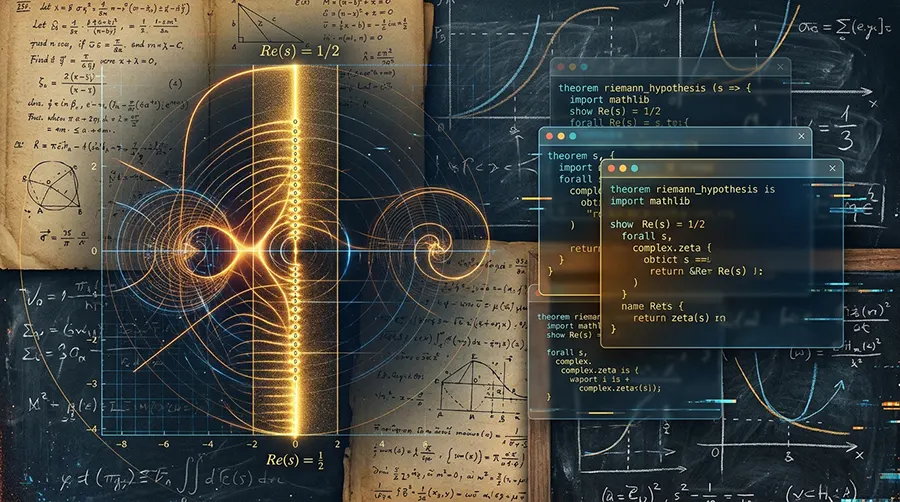
Formulated by the German mathematician Bernhard Riemann, the conjecture concerns the distribution of the “non-trivial zeros” of the celebrated zeta function ($\zeta$). It asserts that all of these zeros lie neatly aligned along a single vertical line in the complex plane (with real part equal to $1/2$).
Behind this highly abstract statement lies a fundamental stakes-filled question: understanding the seemingly random distribution of prime numbers. Prime numbers are the elementary building blocks of arithmetic and form the bedrock of modern cybersecurity (notably RSA encryption). A valid proof—all the more so one extended to the generalized Riemann hypothesis, as Alpöge claims—would open up major breakthroughs in both number theory and cryptography.
Six Weeks of Sprinting and 250,000 Pages Generated with Claude
To reach this result, Levent Alpöge engaged in a human-machine collaboration of rare intensity between October 6 and November 16, 2026:
- The AI outpacing the researcher: The mathematician explains that he guided the initial intuitions by extending a well-known method by Sergei Stepanov. Soon, however, the AI took the lead in technical territory where the researcher admits having less mastery, such as higher-rank automorphic forms: “Claude flew, danced, and sparkled near the finish line,” he wrote in his introductory note.
- From unreadable draft to formalization in Lean: The raw text generated by the AI—nicknamed “the book”—exceeds 250,000 pages. Deemed unreadable as it stood by Alpöge himself, this draft was translated into an archive of 14 files written in Lean, a programming language that serves as an interactive theorem prover.
The Courtroom of Code: How the Community Verifies the Proof
The announcement has sparked a mix of excitement, caution, and skepticism across the international mathematical community, raising several key issues:
- The rigor of Lean: Unlike a human who might overlook a careless slip in a proof spanning hundreds of pages, the Lean software acts as an unforgiving judge: it refuses to compile if even a single logical step fails to follow strictly from the foundational axioms.
- The “black box” trap: As Fields Medalist Terence Tao has previously noted regarding recent AI breakthroughs in mathematics, a computer-verified proof establishes that a theorem is true, yet does not always provide an intuitive grasp of why. Alpöge has in fact promised to release a human-readable, streamlined version in the near future.
- A sensitive strategic backdrop: This announcement comes amid a breakneck race among AI labs (just weeks after OpenAI’s claims on other mathematical problems) and the day after Anthropic’s Nasdaq IPO—timing the researcher himself described as “horrible,” while rejecting any suggestion of a publicity stunt.
Cet article est rédigé par Blaise Grenier, Journaliste reporter d'images et auteur. Découvrir le parcours de l'auteur et la charte éditoriale »