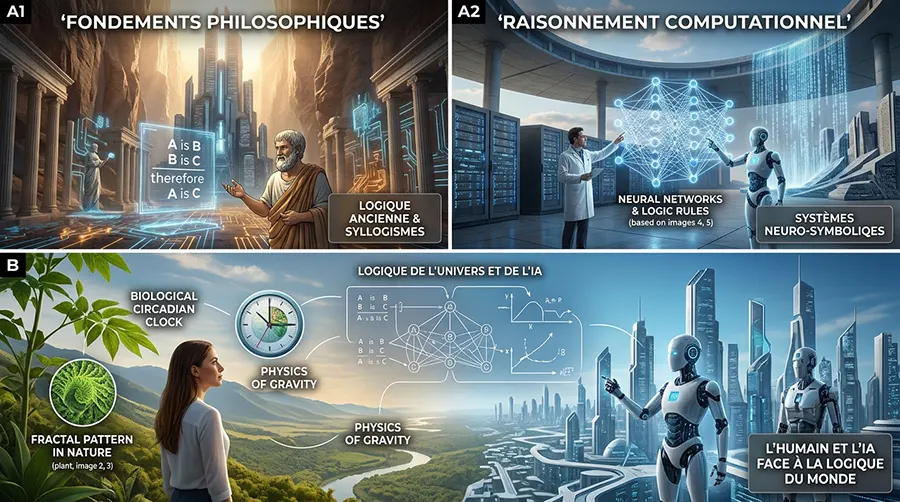
1. What Is Logic? Definition, Scope and Fundamental Principles
Logic, the discipline studying the formal validity of reasoning since antiquity, is a theoretical cornerstone of artificial intelligence. It revolves around logical syntax, semantics and truth conditions, and proof theory to represent and process information rigorously across classical deduction and modern computational systems.
Logic occupies a singular position in the history of science: it is at once an object of philosophical inquiry, a mathematical instrument, a method of proof and, today, one of the theoretical foundations of artificial intelligence. Long before the advent of computers, algorithms and neural networks, ancient civilisations were already questioning the conditions that make it possible to distinguish valid reasoning from a statement that is merely plausible.
This inquiry, initially concerned with the analysis of propositions, concepts and arguments, gradually gave rise to a formalised discipline capable of representing knowledge in symbolic form, breaking down complex problems and establishing rigorous relationships between information.
Today, this history has taken on considerable technological significance. Depending on their architectures, artificial intelligence systems rely on statistical classification mechanisms, mathematical representations, inference procedures, formal constraints and probabilistic models. Large language models, expert systems, autonomous agents and intelligent robots thus draw, to varying degrees, on principles whose origins can be traced to several centuries of logical research.
To understand both the possibilities and the limitations of contemporary artificial intelligence, it is therefore necessary to return to the foundations of logic, examine its historical transformations and study the various ways in which it operates within computer systems.
The purpose is not simply to retrace a succession of philosophical doctrines. The central issue is to understand how a discipline devoted to the validity of reasoning became an operational tool for representing the world, processing information, testing hypotheses, planning actions and contributing to automated decision-making.
This evolution also makes it possible to grasp a fundamental distinction: computation, the recognition of statistical patterns and logical reasoning are three different operations, which can nevertheless be combined within a single intelligent system.
1.1. A discipline concerned with the validity of reasoning
Logic may be defined as the systematic study of the principles and rules that determine the validity of reasoning.
It is concerned in particular with the relationships between propositions, the truth conditions of statements, the operations through which a conclusion can be derived from premises, and the structure of proofs.
Its primary purpose is therefore not to determine whether a statement actually corresponds to reality, but to establish whether a conclusion follows correctly from the information on which it is based.
This distinction is essential.
Consider the following argument:
- All mammals are animals.
- All dogs are mammals.
- Therefore, all dogs are animals.
The conclusion necessarily follows from the two premises. The argument is logically valid, irrespective of how the knowledge in question was acquired.
Logic is concerned precisely with this property: the preservation of validity throughout a chain of deductive reasoning.
An argument may nevertheless be perfectly valid while resting on a false premise. Formal validity alone therefore does not guarantee the empirical truth of the knowledge being used.
This distinction between the structure of an argument and the truth of its premises is one of the foundations of modern logic.
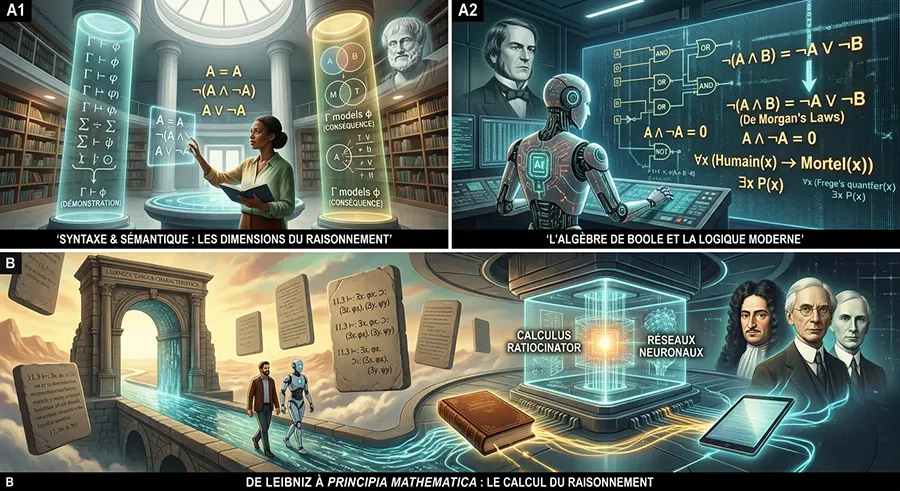
1.2. The three dimensions of reasoning
The study of logic can be approached through three broad, complementary dimensions.
Logical syntax
This concerns the way in which expressions are constructed and combined.
It defines, in particular:
- The permitted symbols.
- Variables.
- Logical constants.
- Rules for forming expressions.
- Axioms and rules of inference.
Syntax makes it possible to determine whether an expression actually belongs to a given formal system.
Logical semantics
This examines the meaning of formal expressions and the conditions under which they are true or false.
It makes it possible, in particular, to define:
- Possible interpretations.
- Models.
- Truth values.
- Satisfaction conditions.
- Logical consequence relations.
Proof theory
This examines the mechanisms through which a conclusion can be derived from axioms and rules of inference.
A proof consists of a sequence of steps, each of which must be justified in accordance with the rules of the system under consideration.
These three dimensions are particularly important in computer science: a programme can check the syntactic structure of a formula, determine whether it is satisfied in a model, and search for a proof establishing its validity.
1.3. The major principles of classical logic
Classical logic traditionally rests on several fundamental principles.
The principle of identity
A proposition or an object is identical to itself.
It is expressed symbolically as follows:
[ A = A ]
This principle ensures the stability of objects and terms within an argument.
In computing, it is involved in comparison operations, entity identification and the verification of equality between values.
The principle of non-contradiction
A proposition and its negation cannot both be true simultaneously in classical logic.
[ \neg(A \land \neg A) ]
In other words, a statement cannot be both true and false at the same time and in the same respect.
This principle is central to formal verification systems and consistent knowledge bases.
The principle of the excluded middle
A proposition is either true or false, with no third truth value in classical bivalent logic.
[ A \lor \neg A ]
This principle does not mean that an observer necessarily knows the answer. It merely indicates that, within the classical semantic framework under consideration, one of the two possibilities is true.
This distinction between truth and knowledge is particularly important in artificial intelligence, where a system may be unable to determine whether a proposition is true or false because it lacks sufficient information.
The principle of sufficient reason
Associated above all with Leibniz’s philosophy, this principle holds that every fact must have a sufficient reason or explanation.
It is not a universal axiom of classical formal logic, but it represents an important philosophical requirement concerning the intelligibility of reality.
In intelligent systems, this requirement finds a counterpart in research into explainability: where necessary, an automated decision should be accompanied by an intelligible and verifiable justification.
1.4. Validity, truth, consistency and logical consequence
These four notions are frequently confused, although they refer to different properties.
| Notion | Meaning |
|---|---|
| Truth | The correspondence of a proposition to its interpretation or reference model. |
| Validity | A property of an argument whose conclusion necessarily follows from its premises. |
| Consistency | The absence of contradiction according to the rules of the system under consideration. |
| Logical consequence | A relation whereby a conclusion is true in every model satisfying the premises. |
In mathematical notation:
[ \Gamma \models \varphi ]
means that the formula (\varphi) is a semantic consequence of the set of premises (\Gamma).
By contrast:
[ \Gamma \vdash \varphi ]
means that (\varphi) can be proved from (\Gamma) using the rules of the formal system under consideration.
The distinction between these two notations is fundamental: the first expresses a semantic relation, whereas the second expresses a syntactic relation of proof.
A particularly well-designed logical system can establish a correspondence between these two dimensions. The notions of soundness and completeness are precisely intended to examine this relationship.
2. The Historical Origins of Logic: From Antiquity to the Earliest Theories of Reasoning
2.1. Aristotle and the birth of systematic logic
Aristotle (384–322 BC)
The history of systematic logic in the Western tradition conventionally begins with Aristotle (384–322 BC).
This attribution obviously does not mean that earlier civilisations were unfamiliar with reasoning. Babylonian mathematics, Egyptian traditions and Greek argumentative practices already bear witness to the sophisticated use of rational procedures.
Aristotle’s originality lies in his determination to catalogue, formalise and classify the structures of reasoning.
In the treatises subsequently grouped under the title Organon, he develops, in particular, a theory of propositions, categories and syllogisms.
The syllogism is one of the earliest systematic models of deduction.
Its structure rests on two premises from which a conclusion is established.
Example:
- All human beings are mortal.
- Socrates is a human being.
- Socrates is mortal.
The validity of this inference does not depend on the identity of the objects concerned, but on the general structure of the argument.
Aristotelian syllogistic logic thus represents an early attempt to identify abstract rules applicable to different situations.
This discovery is historically decisive: reasoning gradually becomes an object that can be studied independently of its particular content.
2.2. Categories and relationships between concepts
Aristotle’s work is not limited to the analysis of syllogisms.
He also studies categories, predicates and the various ways in which properties can be attributed to objects.
A proposition such as “Socrates is mortal” establishes a relationship between a subject and a predicate.
This structure makes it possible to distinguish:
- The subject to which the statement refers.
- The predicate expressing a property.
- The copula establishing the relationship between the two.
This analysis constitutes a historical precursor to predicate logic, although the latter would be developed much later in a considerably more powerful mathematical form.
The distinction between universal and particular propositions also plays a major role.
Categorical propositions can take the following forms, among others:
| Type | Structure | Example |
|---|---|---|
| Universal affirmative | All A are B | All human beings are mortal. |
| Universal negative | No A are B | No square is a circle. |
| Particular affirmative | Some A are B | Some animals are nocturnal. |
| Particular negative | Some A are not B | Some birds cannot fly. |
This classification would be revisited, discussed and further developed over many centuries.
2.3. The Megarians and the Stoics: another conception of logic
Another ancient tradition deserves particular attention: that of the Megarian and Stoic schools.
Unlike Aristotelian logic, which focuses primarily on terms, properties and classes, the Stoics developed a logic of propositions.
This difference anticipates certain aspects of contemporary propositional calculus directly.
Chrysippus of Soli, a major figure in Stoicism, contributed in particular to the study of relationships between propositions.
The Stoics examined structures such as:
- If A, then B.
- A and B.
- A or B.
- Not A.
They also developed patterns of inference, several of which correspond to forms of reasoning now recognised in propositional logic.
Modus ponens is a particularly important example:
[ (A \rightarrow B) \land A \Rightarrow B ]
If A implies B, and A is true, then B is true.
Modus tollens is another fundamental form:
[ (A \rightarrow B) \land \neg B \Rightarrow \neg A ]
If A implies B, and B is false, then A is false.
These patterns are still used in automated deduction systems.
The Stoics were also interested in the meaning of propositions and in the distinction between linguistic expressions, the objects they designate and the contents they signify.
Their concept of lekton refers, in particular, to the meaningful content associated with an expression.
This approach has particular resonance with contemporary research into knowledge representation, computational semantics and natural language interpretation.
2.4. Paradoxes: when reasoning encounters its own limits
Antiquity also saw the emergence of several logical paradoxes.
The most famous is the Liar Paradox, associated in particular with Eubulides of Miletus.
A person states:
“This sentence is false.”
If the sentence is true, then it is false. If it is false, then it is true.
This paradox reveals the difficulties associated with self-reference and with applying certain notions of truth to expressions that refer to themselves.
These problems are not merely philosophical curiosities.
They anticipate essential questions in mathematical logic, set theory, formal semantics and theoretical computer science.
Modern computer systems also encounter problems involving self-reference, recursive definitions and the properties of programmes.
The study of paradoxes thus helped demonstrate that apparently straightforward reasoning can lead to profound difficulties whenever the rules of reference and the conditions of truth have not been precisely defined.
3. Medieval Logic: A Major Period of Conceptual Development
3.1. The transmission and transformation of the ancient legacy
Medieval logic was a particularly important period, long underestimated in general histories of the discipline.
Aristotle’s works were transmitted, translated and commented upon within several intellectual traditions.
Scholars in the Arabic- and Persian-speaking world played an essential role in this circulation of knowledge.
Al-Farabi, Avicenna and Averroes contributed, in particular, to the development of Aristotelian logic and its integration into medieval philosophy.
Their work was not limited to preserving an ancient legacy: they helped deepen and transform it.
In the Latin West, translations and commentaries gradually encouraged the emergence of an especially sophisticated scholastic logic.
3.2. Abelard and the analysis of language
Peter Abelard (1079–1142) occupies an important place in this development.
His work deals, in particular, with the meaning of terms, propositions and the relationships between logic and metaphysics.
The problem of universals is one of his principal areas of inquiry.
It concerns, among other things, whether general notions such as “human being”, “animal” or “species” correspond to independent realities or to conceptual constructions.
This question connects with a problem that remains present in artificial intelligence: how can general categories be represented on the basis of individuals and particular observations?
A classification system must determine precisely which characteristics make it possible to group different objects within the same category.
3.3. Supposition theory and the meaning of terms
Medieval logicians developed an especially sophisticated analysis of how linguistic expressions function.
Supposition theory examines, in particular, the different roles a term can play within a proposition.
An important distinction is that between material supposition and formal supposition.
In the first case, a term refers to the word itself.
Example:
“The word intelligence contains twelve letters.”
In the second case, the term refers to what it denotes.
Example:
“Intelligence plays a role in problem-solving.”
This distinction corresponds to one that remains important in computer science and linguistics: the distinction between an expression used as a linguistic object and its use to designate something external.
It also connects with contemporary notions of use and mention, and of syntactic representation and semantic content.
3.4. Logical consequences and early formal analyses
Fourteenth-century logicians considerably deepened the study of logical consequence.
William of Ockham, Walter Burley and John Buridan contributed, in particular, to the analysis of inferences and relationships between propositions.
An essential distinction emerged between formal consequence and material consequence.
A formal consequence remains valid by virtue of its logical structure, independently of the particular content of its terms.
A material consequence may also depend on the meaning of the expressions used.
This distinction anticipates certain modern developments in formal logic and semantics.
Medieval treatises on consequence also contain principles that can be found today in propositional calculus and predicate calculus.
Medieval logic should therefore not be regarded merely as a period of transmission. It represents a genuine conceptual laboratory in which methods of linguistic analysis and rules of inference were developed, and these would retain their importance over the centuries.
4. From Leibniz to the Mathematisation of Logic
4.1. Leibniz and the project of a universal language
Gottfried Wilhelm Leibniz (1646–1716) occupies a pivotal position in the history of logic.
His ambition went far beyond improving traditional syllogistic logic.
He envisaged the possibility of constructing a universal language capable of representing concepts through symbols and resolving certain controversies by means of calculation.
His project rested on two major ideas:
- A lingua characteristica universalis, intended to represent knowledge in a symbolic language.
- A calculus ratiocinator, intended to perform operations of reasoning on the basis of that representation.
The idea was remarkably far-sighted.
If knowledge could be represented within a sufficiently precise formal system, certain intellectual operations could be carried out mechanically.
Under certain circumstances, reasoning would become a computable operation.
This conception directly anticipates several strands of modern computer science, symbolic programming and automated theorem proving.
Leibniz would not, however, succeed in constructing an operational universal system that fully met this ambition.
His importance lies above all in his anticipation of a computational conception of reasoning.
4.2. Pascal and the Port-Royal Logic
In 1662, Logic, or the Art of Thinking was published anonymously, written by Antoine Arnauld and Pierre Nicole.
Known as the Port-Royal Logic, this work offers a synthesis of the Aristotelian tradition, scholastic developments and certain modern philosophical approaches.
Its structure distinguishes four major operations:
- Ideas.
- Judgement.
- Reasoning.
- Method.
The work places particular emphasis on the comprehension and extension of concepts.
Comprehension refers to the properties that constitute an idea.
Extension corresponds to the set of objects to which that idea can be applied.
This distinction remains fundamental to understanding classification systems and computational ontologies.
A category has both a definition and a domain of application. Consistency between these two dimensions determines the quality of knowledge representation.
4.3. George Boole: logic becomes an algebra
4.3. George Boole: Logic Becomes an Algebra
<PRIVATE_PERSON>
The decisive mathematical turning point came in the nineteenth century.
In 1847, George Boole published The Mathematical Analysis of Logic.
In 1854, he further developed his approach in An Investigation of the Laws of Thought.
His aim was to represent logical operations through algebraic structures.
Logic thus became amenable to manipulation according to mathematical rules.
In Boolean algebra, variables can take two values:
[ 0 \quad \text{or} \quad 1 ]
These values are generally interpreted as false and true.
The fundamental operations include:
Conjunction
[ A \land B ]
It is true when both propositions are true.
Inclusive disjunction
[ A \lor B ]
It is true when at least one of the two propositions is true.
Negation
[ \neg A ]
It reverses the logical value of a proposition.
The fundamental laws include, in particular:
[ A \land 1 = A ]
[ A \lor 0 = A ]
[ A \land A = A ]
[ A \lor A = A ]
[ A \land \neg A = 0 ]
[ A \lor \neg A = 1 ]
De Morgan’s laws also make it possible to transform logical expressions:
[ \neg(A \land B) = \neg A \lor \neg B ]
[ \neg(A \lor B) = \neg A \land \neg B ]
These operations now form the mathematical foundation of digital logic circuits.
Processors, electronic memory and digital systems use physical devices capable of performing operations corresponding to these logical functions.
Modern computing therefore owes an essential part of its theoretical foundations to Boole’s mathematical formalisation of logic.
4.4. De Morgan and Peirce: Relations and Truth Functions
Augustus De Morgan contributed to the expansion of algebraic logic.
In particular, he developed the study of relations and formulated the laws that now bear his name.
Charles Sanders Peirce also advanced the logic of relations, truth functions and the operations used to transform propositions.
These contributions gradually made it possible to move beyond a logic concerned exclusively with the properties of objects.
A relation could henceforth be studied in its own right.
Example:
- Alice is Bob’s mother.
- Bob is Claire’s brother.
- Alice lives in Paris.
These statements do not merely describe individual properties. They establish relationships between several entities.
This development is particularly important for contemporary artificial intelligence, since knowledge graphs, relational databases and semantic representation systems are precisely based on the organisation of entities and relationships.
5. Frege and the Birth of Modern Mathematical Logic
5.1. Gottlob Frege: A Revolution in the Formalisation of Reasoning
Gottlob Frege (1848–1925) is one of the central figures in modern logic.
In 1879, he published Begriffsschrift, a work in which he introduced a system of notation designed to express rigorously the logical structure of propositions and proofs.
His essential contribution was to move beyond the limitations of traditional term logic.
He developed a predicate logic capable of representing far more complex relationships.
The systematic introduction of quantifiers represented a decisive advance.
Two symbols play a major role:
[ \forall x ]
The universal quantifier means “for all x”.
[ \exists x ]
The existential quantifier means “there exists at least one x”.
Consider:
[ \forall x ; (Humain(x) \rightarrow Mortel(x)) ]
This formula means that every individual belonging to the category of human beings has the property of being mortal.
Logic could now represent general structures of knowledge with far greater precision than traditional syllogistic logic had allowed.
5.2. Sense and Reference: A Fundamental Distinction
In his article Über Sinn und Bedeutung, published in 1892, Frege developed a fundamental distinction between sense and reference.
Two expressions may refer to the same object while conveying different senses.
The classic example is that of the morning star and the evening star, two expressions that both refer to Venus.
This distinction makes it possible to better understand the problems associated with the meaning of expressions and their interpretation.
This question remains central to artificial intelligence.
Two different linguistic expressions may refer to the same entity. Conversely, an identical expression may have several meanings depending on its context.
The resolution of ambiguity, entity disambiguation and the semantic representation of natural language extend these questions in different technical forms.
5.3. Logicism and the Foundations of Mathematics
Frege also developed the logicist project.
This approach seeks to establish that mathematics—or at least an essential part of its foundations—can be reconstructed from logical principles.
In particular, he attempted to define numbers in terms of logical concepts.
This undertaking encountered a major difficulty when Bertrand Russell discovered a contradiction in the system of Grundgesetze der Arithmetik.
Russell’s paradox exposed the dangers of an overly permissive definition of sets.
The question of the logical foundations of mathematics consequently took on a new dimension.
It led to the development of more rigorous axiomatic theories and to deeper reflection on the limitations of formal systems.
5.4. Russell, Whitehead and Principia Mathematica
Between 1910 and 1913, Bertrand Russell and Alfred North Whitehead published the three volumes of Principia Mathematica.
Their ambition was to reconstruct a substantial part of mathematics from a formalised logical system.
Among other things, they introduced a theory of types designed to avoid certain contradictions encountered in naive set theories.
The logicist project represents a major milestone in the history of formalisation.
It demonstrates that extremely elaborate mathematical constructions can be studied through systems of symbols, axioms and transformation rules.
This conception is one of the historical foundations of formal verification and programming languages based on type systems.
6. Logic in the Twentieth Century: Proof, Computability and the Limits of Formal Systems
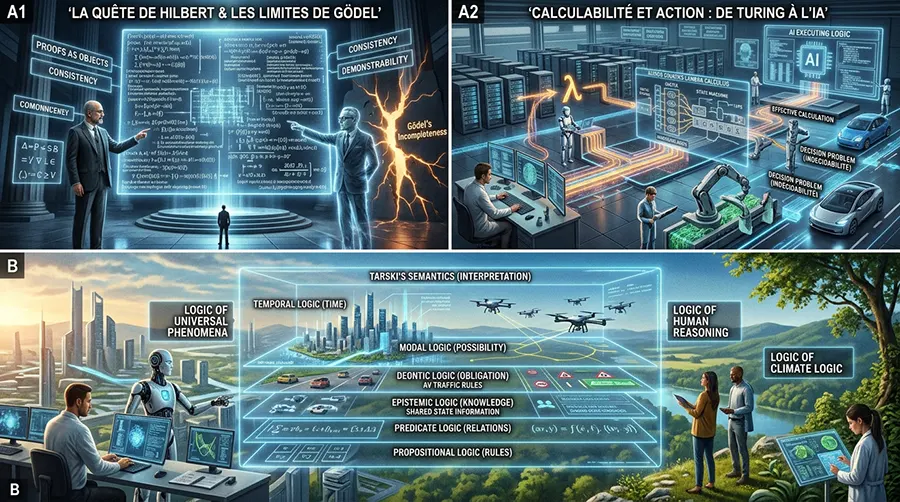
6.1. Hilbert and the Formalisation Programme
At the beginning of the twentieth century, David Hilbert developed a programme aimed at establishing the consistency of mathematics through rigorous formal methods.
The idea was, in particular, to represent proofs as sequences of symbols manipulated according to explicit rules.
A proof thus became a mathematical object that could itself be studied.
This approach gave rise to metamathematics and contributed to the development of proof theory.
The question was no longer merely whether a proposition could be proved, but also what properties the system enabling that proof possessed.
Three questions became essential:
- Is the system consistent?
- Are all the truths under consideration provable?
- Is there a general procedure for deciding whether a proposition is provable?
These questions would have far-reaching consequences for theoretical computer science.
6.2. Gödel: The Incompleteness Theorems
In 1931, Kurt Gödel published his famous incompleteness theorems.
These results revolutionised research into the foundations of mathematics.
The first theorem establishes that every consistent, effectively axiomatized formal system sufficiently expressive to formalise a portion of arithmetic contains propositions that cannot be proved within that system, under the appropriate technical assumptions.
The second theorem shows that such a system generally cannot prove its own consistency using only its own formal resources, under the usual conditions of consistency and formalisation.
These results impose a fundamental limit on the ambition to construct a single formal system capable of proving every relevant mathematical truth while also establishing its own consistency.
They do not, however, mean that all automated proving is impossible.
Rather, they show that the capabilities of a formal system are necessarily limited by its structure and by the resources available to it.
This distinction is important for artificial intelligence: a theorem-proving engine can be extremely effective within a formalised domain without being capable of solving every conceivable mathematical question.
6.3. Church and Turing: The Birth of Computability Theory
In 1936, Alonzo Church and Alan Turing made fundamental contributions to our understanding of computational procedures.
Church developed the lambda calculus and formulated a mathematical approach to computability.
Turing introduced an abstract machine model that made it possible to define precisely what constitutes an effective computational procedure.
The Turing machine consists of a theoretical device capable of reading, writing and modifying symbols on a tape according to a set of specified instructions.
This model makes it possible to study the limits of mechanical computation.
The Church–Turing thesis establishes a fundamental correspondence between different formal definitions of the intuitive notion of effective computation.
It constitutes one of the conceptual foundations of theoretical computer science.
Logic and computation thus become two deeply interconnected fields.
Formalised reasoning can be executed as a procedure involving symbolic transformations, provided that the system in question is sufficiently precise and that its operations are effectively computable.
6.4. The Entscheidungsproblem and Undecidability
The decision problem, or Entscheidungsproblem, consists in seeking a general procedure for determining whether a logical formula is universally valid.
Church and Turing showed that no such general procedure exists for first-order logic.
This impossibility does not mean that all formulas are undecidable.
There are numerous logical fragments for which efficient decision procedures can be constructed.
Propositional calculus, for example, has a finite decision procedure based on examining all possible combinations of truth values.
By contrast, complexity increases considerably when quantifiers and more elaborate structures are involved.
This distinction is crucial in computer applications.
Verification systems often use carefully selected logical fragments precisely because they make it possible to obtain sufficiently efficient solving procedures.
6.5. Tarski and Formal Semantics
Alfred Tarski made a profound contribution to the formalisation of the concept of truth.
His approach makes it possible to define the conditions under which a proposition is true relative to a given interpretation.
This approach constitutes one of the foundations of model theory.
A model can be understood as a mathematical structure in which the symbols of a formal language are assigned a precise interpretation.
Model theory therefore makes it possible to study the relationship between formal expressions and the structures they describe.
In artificial intelligence, this conception is involved in knowledge bases, ontologies, semantic representation systems and constraint verification.
6.6. The Limits of Automated Theorem Proving
The history of modern logic shows that the automation of reasoning is possible, but that it depends on specific conditions.
Some problems are decidable.
Others are undecidable.
Some can be solved efficiently.
Others require considerable computational resources.
This distinction is particularly important in artificial intelligence systems.
A program may be capable of verifying a proof whose validity is guaranteed without being able to discover a proof quickly for every conceivable problem.
Verification and proof search are two distinct operations.
This difference explains why proof assistants, logical solvers and generative models perform complementary rather than interchangeable functions.
7. The Main Families of Contemporary Logic
Modern logic does not constitute a single system.
It encompasses several theoretical families, each suited to particular problems.
7.1. Propositional Logic
Propositional logic studies the relationships between propositions considered as elementary units.
It uses, in particular, the following logical connectives:
| Symbol | Operation | Meaning |
|---|---|---|
| ¬ | Negation | Not A |
| ∧ | Conjunction | A and B |
| ∨ | Disjunction | A or B |
| → | Implication | If A, then B |
| ↔ | Equivalence | A if and only if B |
Consider two propositions:
- A: the sensor detects an obstacle.
- B: the robot triggers an emergency stop.
The following rule can be formalised:
[ A \rightarrow B ]
If the sensor detects an obstacle, the robot must trigger a stop.
Propositional logic makes it possible to verify the consistency of this type of rule and determine the consequences of different combinations of truth values.
It is used in electronic circuits, verification programs, SAT solvers and many decision-making systems.
7.2. Truth Tables
Truth tables are a basic yet extremely powerful instrument.
For two propositions A and B, conjunction has the following properties:
| A | B | A ∧ B |
|---|---|---|
| True | True | True |
| True | False | False |
| False | True | False |
| False | False | False |
Inclusive disjunction works differently:
| A | B | A ∨ B |
|---|---|---|
| True | True | True |
| True | False | True |
| False | True | True |
| False | False | False |
These tables make it possible to mechanically determine the truth values of compound expressions.
They also provide a theoretical foundation for the logical operations performed by processors.
7.3. Predicate Logic
Predicate logic extends propositional logic by introducing variables, relations and quantifiers.
It makes it possible to express general properties concerning sets of objects.
Example:
[ \forall x ; (Robot(x) \rightarrow Machine(x)) ]
This formula states that every robot belongs to the category of machines.
Another formula can express a relationship:
[ \exists x ; (Robot(x) \land WorksWith(x,Human)) ]
It states that there exists at least one robot that works with a human.
Predicate logic is a central instrument in the symbolic representation of knowledge.
It makes it possible to formalise the properties of objects, the relationships between entities and the conditions required for certain conclusions.
7.4. First-Order and Second-Order Logic
First-order logic quantifies over individuals.
Second-order logic also makes it possible to quantify over properties, relations or sets of individuals, depending on the system under consideration.
This distinction has important consequences for expressive power and metatheoretical properties.
First-order logic has, in particular, fundamental soundness and completeness theorems.
Second-order logic, under its standard semantics, has different properties and does not possess a complete effective proof system in the corresponding sense.
The choice of logical system therefore depends on the representational requirements and the guarantees being sought.
7.5. Modal Logic
Modal logic studies the notions of necessity and possibility.
It introduces two fundamental operators:
[ \Box A ]
A is necessary.
[ \Diamond A ]
A is possible.
These operators make it possible to study situations in which the truth of a proposition depends on different possible worlds or different accessible configurations.
Modal logic has several applications:
- Reasoning about possibilities.
- Knowledge representation.
- Belief representation.
- Computer system verification.
- The study of concurrent behaviour.
- Planning under constraints.
In an autonomous system, a modal rule could express that an action is possible in certain configurations but impossible in others.
7.6. Temporal Logic
Temporal logic makes it possible to represent properties that evolve over time.
It is particularly important for reactive systems and autonomous robots.
It can be used to formalise properties such as:
- An alarm is always eventually triggered after a danger has been detected.
- A robot must never enter a restricted area.
- A command must be executed after a signal is received.
- A system must eventually return to its initial state.
Temporal logics such as LTL and CTL are widely used in formal verification.
They make it possible to describe not only the states of a system, but also the possible trajectories between those states.
7.7. Epistemic Logic
Epistemic logic studies knowledge and beliefs.
It makes it possible, in particular, to represent what an agent knows, what it does not know and what it believes it knows.
This family of logic is particularly relevant to multi-agent systems.
One robot may possess information that another robot does not know.
A software agent may also need to distinguish certain information from a provisional assumption.
Epistemic logic makes it possible to formalise these distinctions.
7.8. Deontic Logic
Deontic logic studies the notions of obligation, prohibition and permission.
It makes it possible to represent normative rules.
Examples:
- A robot must stop when faced with an obstacle.
- An autonomous vehicle must not cross a red light.
- A system is authorised to access a resource under certain conditions.
This approach has applications in the representation of compliance rules, autonomous systems and decision-making architectures subject to regulatory constraints.
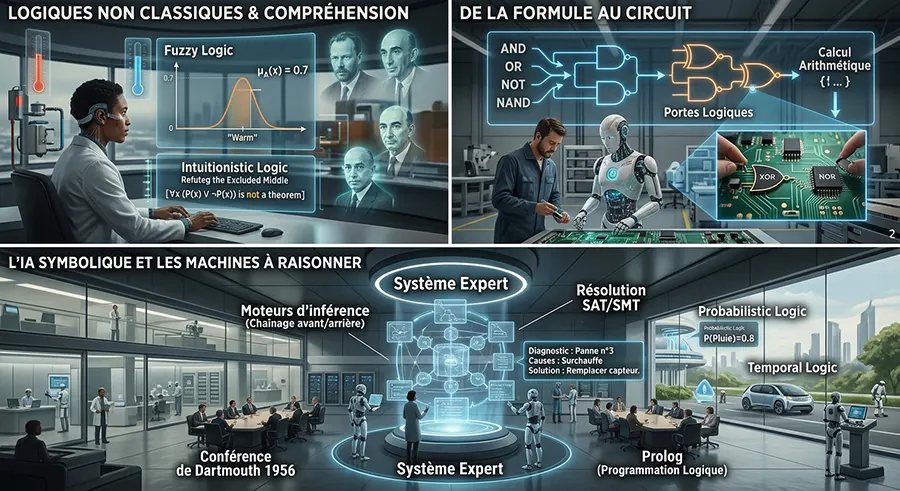
7.9. Intuitionistic Logic
Intuitionistic logic, developed notably from the work of Luitzen Brouwer and formalised by Arend Heyting, proposes a different conception of proof.
In particular, it does not systematically regard the law of excluded middle as universally valid.
A proposition is not necessarily considered proved merely because its negation cannot be established.
Mathematical existence is associated with the possibility of effectively constructing the object in question.
This approach has important extensions in theoretical computer science.
The Curry–Howard correspondence, in particular, establishes a profound relationship between propositions and types, as well as between proofs and programs.
This correspondence is particularly important for functional programming languages and proof assistants.
7.10. Fuzzy Logic
Fuzzy logic, developed from Lotfi Zadeh’s work published in 1965, makes it possible to represent degrees of membership in a category.
Unlike classical bivalent logic, it does not systematically reduce properties to an opposition between true and false.
A temperature, for example, may be considered to belong to the category “hot” with a membership degree of 0.7.
A fuzzy variable can be represented by a membership function:
[ \mu_A(x) \in [0,1] ]
This approach is particularly useful when categories are imprecise.
Possible applications include:
- Industrial control.
- Temperature regulation.
- Technical system management.
- Embedded electronics.
- Motor control.
- Process automation.
Fuzzy logic should not, however, be confused with probability.
A membership degree expresses the extent to which something belongs to a fuzzy category, whereas probability represents a measure of uncertainty concerning an event or hypothesis.
7.11. Paraconsistent Logic
Classical logic considers that a contradiction can lead to extremely problematic consequences when handled without appropriate safeguards.
In certain contexts, particularly real-world databases, contradictions are nevertheless unavoidable.
Two sources may provide incompatible information.
A medical system may contain contradictory records.
A knowledge network may incorporate data updated at different times.
Paraconsistent logic studies systems capable of handling certain contradictions without automatically making every proposition derivable.
This property is particularly interesting for intelligent systems that must operate with imperfect information.
7.12. Probabilistic Logic
Probabilistic logic combines logical structures with probability measures.
It makes it possible to represent uncertain knowledge.
Example:
[ P(Rain) = 0.8 ]
This value indicates an 80% probability for the event in question, relative to the model being used.
Probabilistic models can be associated with logical relationships in order to represent complex and uncertain knowledge.
They are involved in particular in:
- Bayesian networks.
- Probabilistic graphical models.
- Diagnostic systems.
- Risk analysis.
- Probabilistic robotics.
- Statistical artificial intelligence.
This family of approaches makes it possible to move beyond entirely deterministic reasoning when the available information does not support certain conclusions.
8. Logic and Computer Science: How Reasoning Becomes Computable
8.1. From Mathematical Formula to Computer Program
Logic and computer science have a structural relationship.
A computer manipulates numerical representations according to precise instructions.
A program can be regarded as a sequence of formalised operations designed to transform data.
In certain architectures, the operations performed correspond directly to logical functions.
This relationship appears at several levels:
- Electronic circuits.
- Algorithms.
- Data structures.
- Programming languages.
- Rule-based systems.
- Inference engines.
- Formal verification.
Boolean algebra, in particular, constitutes an essential mathematical foundation of digital circuits.
8.2. Logic Gates
Logic gates are electronic components that perform Boolean operations.
<PRIVATE_PERSON>
The main logic gates are:
AND
The output is 1 only if all inputs are 1.
OR
The output is 1 when at least one input is 1.
NOT
The output reverses the value of the input.
NAND
The output is the inverse of the result of AND.
NOR
The output is the inverse of the result of OR.
XOR
The output is 1 when the two inputs are different.
These operations can be combined to construct complex circuits.
Processors use combinations of logic gates to perform arithmetic operations, comparisons and data transformations.
Logic thus becomes a physical reality.
8.3. Type Systems and the Curry–Howard Correspondence
The Curry–Howard correspondence establishes a profound connection between mathematical logic and programming languages.
It can be summarised through three correspondences:
| Logic | Computer Science |
|---|---|
| Proposition | Type |
| Proof | Program |
| Proof simplification | Program reduction |
A logical proposition corresponds to a computational type.
A proof of that proposition corresponds to a program possessing that type.
This correspondence underpins several formal verification systems.
In particular, it makes it possible to construct programs whose certain properties are guaranteed by their type systems.
Tools such as Coq, Lean and Agda exploit different forms of this relationship.
8.4. Logic Programming
Logic programming is a computational approach in which programs are expressed primarily in the form of facts and rules.
Unlike conventional imperative programming, which explicitly describes a sequence of instructions, logic programming describes the relationships and conditions required to obtain an answer.
Prolog is one of the best-known historical languages in this family.
Conceptual example:
parent(alice, bob).
parent(bob, claire).

grandparent(X, Z) :-
    parent(X, Y),
    parent(Y, Z).
The system can infer that:
grandparent(alice, claire).This deduction relies on the automatic application of a general rule to known facts.
Logic programming is therefore a direct extension of predicate logic.
8.5. Inference Engines
An inference engine is a software component responsible for applying reasoning rules to a body of knowledge.
It may use, in particular:
- Forward chaining.
- Backward chaining.
- Unification.
- Resolution.
- Production rules.
- Search strategies.
Forward chaining starts with the available facts and applies rules to generate new facts.
Backward chaining starts with a conclusion being investigated and works backwards towards the conditions required to prove it.
These two methods serve different purposes.
A diagnostic system may use backward chaining to test a medical hypothesis.
A monitoring system may use forward chaining to automatically detect a dangerous situation from several signals.
8.6. SAT and SMT Solvers
SAT and SMT solvers are major tools in modern computer science.
A SAT solver seeks to determine whether a propositional formula can be made true through an appropriate assignment of values to its variables.
An SMT solver extends this approach by incorporating mathematical theories.
It can deal, in particular, with:
- Arithmetic.
- Equality.
- Arrays.
- Functions.
- Integer constraints.
- Certain data structures.
These tools are used in program verification, electronic circuit validation, combinatorial problem solving and planning.
They perfectly illustrate how the principles of formal logic can be transformed into operational computational tools.
9. Symbolic Artificial Intelligence: The First Reasoning Machines
9.1. The Birth of Artificial Intelligence
Artificial intelligence emerged as an autonomous scientific field in the middle of the twentieth century.
The 1956 Dartmouth Conference is generally regarded as a founding event.
The earliest research sought, in particular, to reproduce certain human capabilities through computer programs.
Problem-solving, mathematical proofs, games and the symbolic processing of knowledge occupied an important place.
This initial orientation is often referred to as symbolic artificial intelligence.
It is based on the idea that certain forms of intelligent behaviour can be reproduced through the manipulation of symbols and the application of explicit rules.
9.2. The Symbolic Hypothesis
The symbolic approach assumes that knowledge can be represented in a structured form.
An intelligent system can then manipulate these representations to produce conclusions.
Example:
- An object has wheels.
- It has an engine.
- It is designed to transport people.
- It belongs to the category of vehicles.
A symbolic architecture can represent these properties as facts and apply rules to classify the object.
This method has an important advantage: the knowledge and rules being used are generally explicit.
The system can therefore provide a formal justification for certain decisions.
9.3. Expert Systems
Expert systems are among the major historical applications of symbolic artificial intelligence.
They generally rely on two main components:
- A knowledge base.
- An inference engine.
The knowledge base contains facts and rules.
The inference engine uses these elements to establish conclusions.
A medical expert system, for example, can associate symptoms with diagnostic hypotheses according to rules defined by specialists.
An industrial system can identify a malfunction from the characteristics observed in a machine.
A financial system can apply compliance rules to a transaction.
These architectures have demonstrated that certain forms of expertise can be reproduced in relatively well-structured domains.
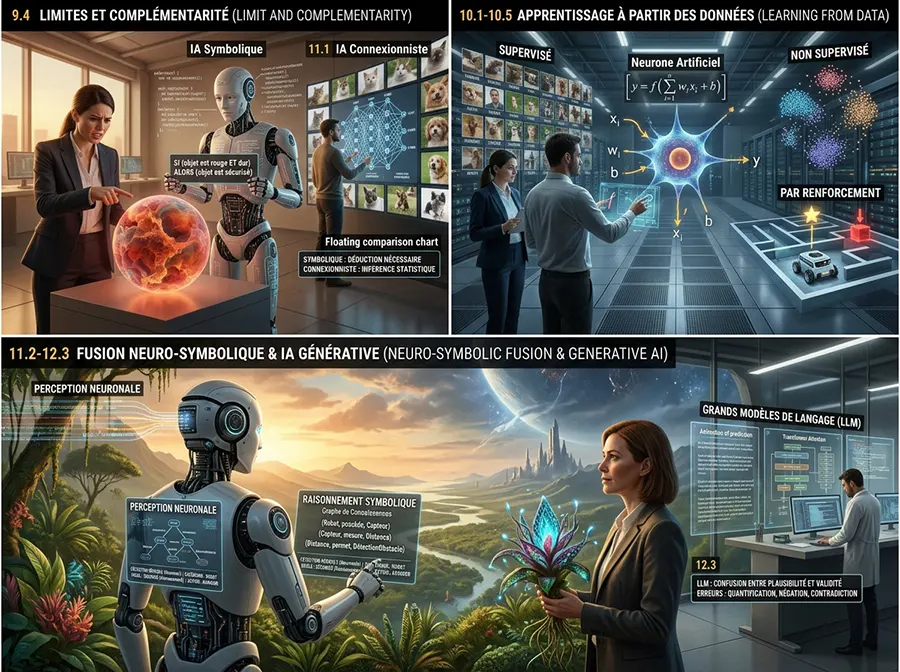
9.4. The Limitations of Symbolic Artificial Intelligence
Despite its strengths, the symbolic approach encounters several difficulties.
It depends heavily on the quality of the knowledge that has been formalised.
It often requires substantial human intervention to construct and maintain its rule bases.
It can also encounter difficulties when interpreting imprecise, ambiguous or changing information.
A robot cannot always determine directly whether an object is fragile, dangerous or accessible using purely symbolic rules.
It must also interpret images, sounds, movements and physical signals.
This difficulty helps explain the development of statistical and connectionist approaches.
10. Connectionist Artificial Intelligence: Learning from Data
10.1. From Programmed Rules to Learned Representations
Connectionist artificial intelligence is based on a different approach.
Rather than representing knowledge exclusively through explicitly programmed rules, it seeks to learn patterns from data.
Artificial neural networks are among the principal architectures in this family.
They consist of computational units organised into layers and connected by numerical parameters.
Learning involves adjusting these parameters in order to minimise a loss function.
This approach makes it possible, in particular, to process complex data:
- Images.
- Videos.
- Texts.
- Sounds.
- Sensory signals.
- Biometric data.
- Information obtained from sensors.
10.2. The Artificial Neuron
An artificial neuron performs a mathematical operation on several inputs.
Its simplified form can be expressed as follows:
[ y = f\left(\sum_{i=1}^{n} w_i x_i + b\right) ]
Where:
- (x_i): input values.
- (w_i): weights associated with the inputs.
- (b): the bias.
- (f): the activation function.
- (y): the neuron’s output.
All the parameters are adjusted during the learning process.
A complex neural network can therefore learn to recognise patterns that would be difficult to describe through explicit rules.
10.3. Supervised Learning
Supervised learning consists of training a model using examples associated with expected outputs.
Example:
A system receives thousands of photographs showing cats and dogs.
Each photograph is associated with a label.
The model progressively learns to identify the statistical characteristics that make it possible to distinguish between the two categories.
The objective is to produce a function capable of generalising to images that were not used during training.
10.4. Unsupervised Learning
Unsupervised learning consists of identifying structures in data without systematically relying on predefined labels.
It can be used, in particular, for:
- Grouping similar data.
- Discovering latent structures.
- Dimensionality reduction.
- Anomaly detection.
- Identifying statistical patterns.
This approach differs fundamentally from logical deduction.
It identifies probable structures from data rather than necessarily proving conclusions from formalised premises.
10.5. Reinforcement Learning
Reinforcement learning is based on interaction between an agent and an environment.
The agent performs actions, observes their consequences and may receive rewards.
The objective is to learn a strategy that maximises cumulative reward.
This method is particularly important in robotics.
A robot can learn to move, grasp objects or perform certain tasks by progressively improving its action policy.
Reinforcement learning can incorporate planning and reasoning mechanisms, but it does not, in itself, constitute formal logic.
11. Logic and Artificial Intelligence: Two Complementary Approaches
11.1. Deductive Reasoning and Statistical Learning
Formal logic and machine learning are based on different principles.
Deductive logic seeks to establish conclusions that necessarily follow from premises according to the rules of a system.
Machine learning seeks to identify patterns from examples.
This distinction can be illustrated by an example.
A logical system receives the following information:
- All objects belonging to category A have property B.
- Object X belongs to category A.
It can therefore deduce that X has property B.
A machine learning system, by contrast, receives thousands of examples of objects A and B.
It progressively learns to recognise a statistical relationship between their observed characteristics.
The first system applies a formal rule.
The second constructs a model from data.
These two methods offer different advantages.
| Symbolic Artificial Intelligence | Connectionist Artificial Intelligence |
|---|---|
| Explicit rules | Learned parameters |
| Structured knowledge | Numerical representations |
| Formal deduction | Statistical inference |
| Rules can be traced | Interpretation can be difficult |
| Strong dependence on formalisation | Strong dependence on data |
| Sometimes limited adaptability | Adaptation through learning |
The complementarity of these two approaches is now one of the most important areas of research in artificial intelligence.
11.2. Neuro-Symbolic Systems
Neuro-symbolic artificial intelligence, often referred to as Neuro-Symbolic AI, seeks to combine the learning capabilities of neural networks with the representational and reasoning properties of symbolic systems.
The objective is to overcome certain limitations inherent in each paradigm.
A neural network can recognise an object in an image.
A logical engine can then use this recognition to apply rules relating to the identified object.
Example:
- A vision system detects a vehicle.
- A symbolic module identifies its category.
- A knowledge base determines the applicable rules.
- A reasoning engine checks the constraints.
- The system produces a decision or proposes an action.
The value of this architecture lies in the complementarity between perception and reasoning.
The neural network provides an interpretation of sensory data.
The logical system uses this interpretation to construct conclusions subject to explicit rules.
The research published in IEEE Transactions on Pattern Analysis and Machine Intelligence in 2025, particularly the review by Wenguan Wang, Yi Yang and Fei Wu, demonstrates the growing importance of this direction.
Scientific source:
https://pubmed.ncbi.nlm.nih.gov/39418157/
11.3. The Main Neuro-Symbolic Architectures
Several integration strategies are being investigated.
Sequential architecture
A neural network produces information that is then passed to a logical engine.
This organisation makes it possible to separate perception and reasoning functions.
Parallel architecture
The neural module and the symbolic module operate simultaneously.
Their results are then combined to produce a decision.
Differentiable integration
Some architectures seek to make logical operations compatible with the optimisation mechanisms used by neural networks.
They employ numerical representations and differentiable approximations of certain symbolic operations.
Constraint-based integration
Logical rules are used to constrain a model’s learning process or its output.
This approach makes it possible to limit predictions that are incompatible with the available knowledge.
11.4. Knowledge Networks and Semantic Graphs
Knowledge graphs are structures designed to represent entities and the relationships between them.
They make it possible to organise information in a form that can be explored and processed by computer systems.
A knowledge graph generally consists of:
- Entities.
- Relationships.
- Attributes.
- Properties.
- Logical or semantic constraints.
For example:
- Paris is the capital of France.
- France is a member of the European Union.
- The European Union is an international political and economic organisation.
These relationships can be represented as a network of interconnected entities.
A simplified representation is:
[ Subject \rightarrow Relationship \rightarrow Object ]
For example:
[ Paris \rightarrow CapitalOf \rightarrow France ]
This type of representation is particularly useful for semantic search, knowledge management and certain forms of automated reasoning.
Knowledge graphs can also be combined with neural networks and language models.
They provide structured information that can supplement the statistical knowledge acquired during model training.
11.5. Ontologies and the Formal Representation of Knowledge
An ontology is a formal representation of the concepts belonging to a particular domain and the relationships between them.
It can define:
- Classes.
- Subclasses.
- Properties.
- Relationships.
- Restrictions.
- Logical axioms.
For example, an ontology relating to robotics might define the following hierarchy:
- Machine.
- Autonomous machine.
- Autonomous robot.
- Industrial robot.
- Domestic robot.
- Humanoid robot.
- Autonomous robot.
- Autonomous machine.
It can also specify that an autonomous robot possesses sensors, actuators and a control system.
Ontologies are used in the Semantic Web, knowledge engineering, data integration and certain artificial intelligence architectures.
They make it possible to establish a shared conceptual framework and to check whether information is compatible with the rules of a given domain.
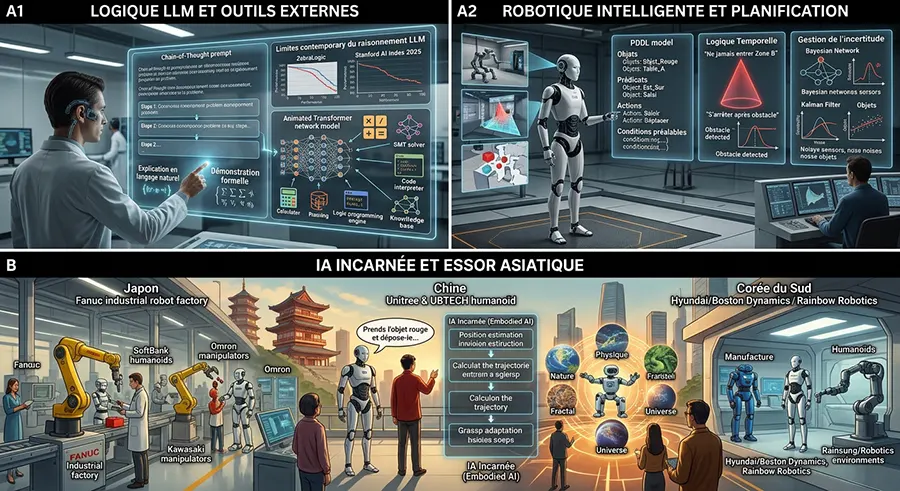
12. Large Language Models: What Role Does Logic Play in Generative AI?
12.1. How Large Language Models Work
Large language models, commonly known as LLMs, are artificial intelligence systems trained on very large collections of textual data.
Their principal objective is to model the statistical relationships between linguistic sequences.
In simplified terms, a language model estimates the probability of a token occurring in a given context.
[ P(x_t \mid x_1, x_2, \ldots, x_{t-1}) ]
Where:
- (x_t) is the token being predicted.
- (x_1, x_2, \ldots, x_{t-1}) represent the preceding context.
The model generates a sequence by successively predicting the most appropriate next token according to its learned parameters and its decoding strategy.
Modern architectures are largely based on the Transformer, introduced in the 2017 paper Attention Is All You Need.
The Transformer uses attention mechanisms to model relationships between different elements of a sequence.
This architecture has enabled major advances in language understanding, text generation and multimodal processing.
However, a fundamental distinction must be made.
A language model does not necessarily manipulate propositions through a formal logical calculus.
It learns statistical representations of linguistic patterns and generates responses based on those representations.
Its ability to produce apparently logical reasoning does not, by itself, establish that it performs formal deduction.
12.2. Vector Representations and Meaning
Large language models transform textual information into numerical representations.
Tokens are converted into vectors within a high-dimensional mathematical space.
These representations make it possible to capture statistical relationships between words, concepts and linguistic contexts.
Words or expressions that occur in similar contexts may acquire representations with certain geometric similarities.
This principle underpins numerous applications:
- Semantic search.
- Text classification.
- Translation.
- Similarity measurement.
- Information retrieval.
- Contextual interpretation.
However, a numerical representation of meaning is not equivalent to a formal logical representation.
A vector can encode statistical relationships without explicitly representing the logical structure of a proposition.
For example, the model may learn that the expressions “all humans are mortal” and “Socrates is a human” are strongly associated with “Socrates is mortal”.
Yet this association is not necessarily the same thing as executing a formal proof based on quantified premises and inference rules.
This distinction is essential when evaluating the reasoning capabilities of generative AI.
12.3. Why Can Language Models Make Logical Errors?
Language models can produce fluent and convincing responses while making logical mistakes.
Several types of errors can occur.
Confusing plausibility with validity
A response may appear coherent without necessarily following from the premises.
Quantifier errors
The model may confuse “all”, “some”, “none” or “at least one”.
Negation errors
A negation may be misinterpreted when several propositions are nested.
Contextual contradictions
A model may produce a statement that conflicts with information provided earlier.
Arithmetic errors
Numerical operations may be incorrect despite an apparently convincing explanation.
Overgeneralisation
A pattern observed in training data may be applied inappropriately to a new situation.
These difficulties show that linguistic generation and logical verification must be distinguished.
12.4. Multi-Step Reasoning
Multi-step reasoning methods seek to improve the resolution of complex problems.
Chain-of-Thought Prompting, popularised in research published in 2022, consists in particular of encouraging the decomposition of a problem into intermediate steps.
This approach can improve performance on certain tasks.
However, a sequence of explanations produced by a model does not automatically constitute a formal proof.
A justification written after a prediction may also fail to correspond exactly to the internal mechanisms that led to that prediction.
It is therefore necessary to distinguish between:
- Producing an explanation in natural language.
- Executing a reasoning procedure.
- Formally verifying a proof.
- Empirically validating a result.
This distinction is fundamental to assessing the actual capabilities of generative AI.
12.5. The Contribution of External Tools and Solvers
To improve the reliability of language models, some architectures allow them to use external tools.
A model may, in particular, delegate an operation to:
- A calculator.
- A search engine.
- A code interpreter.
- A SAT or SMT solver.
- A logic programming engine.
- A proof assistant.
- A structured knowledge base.
This architecture makes it possible to separate linguistic understanding from certain operations that require rigorous verification.
A model can therefore interpret a request, construct a formal representation of the problem, transmit it to a solver and use the result to formulate an answer.
This cooperation between neural models and deterministic tools represents an important direction in contemporary artificial intelligence.
12.6. Contemporary Limitations of LLM Reasoning
Model performance is evolving rapidly, but several studies show that complex reasoning tasks remain difficult.
The Stanford AI Index 2025 report highlights, in particular, that large language models do not always solve arithmetic and planning problems reliably, even when their solutions can be established using formal methods.
A study published in the proceedings of ICML 2025, entitled ZebraLogic: On the Scaling Limits of LLMs for Logical Reasoning, also demonstrates a deterioration in performance as the complexity of constraint problems increases.
The results show that increasing model size and computation time does not systematically eliminate the difficulties encountered with complex logical problems.
Source:
https://proceedings.mlr.press/v267/lin25i.html
It would therefore be excessive to regard language models as universal theorem-proving engines.
Their strength lies in their ability to interpret, generalise, synthesise and produce complex linguistic representations.
Nevertheless, the reliability of their conclusions requires additional mechanisms whenever the stakes demand demonstrable accuracy.
13. Logic and Intelligent Robotics: From Abstract Reasoning to Physical Action
13.1. The Robot as a System of Perception, Decision-Making and Action
Intelligent robotics is a particularly interesting field in which to understand the relationship between logic and artificial intelligence.
An autonomous robot generally has to perform several operations:
- Perceive its environment.
- Interpret the information received.
- Identify a situation.
- Evaluate possible actions.
- Determine a strategy.
- Execute an action.
- Verify the result obtained.
These operations involve different techniques.
Computer vision makes it possible to recognise objects.
Localisation systems estimate the robot’s position.
Planning algorithms determine trajectories.
Logical engines can verify certain constraints.
Neural networks make it possible to learn behaviours from data.
Robotic intelligence therefore results from a combination of perceptual, computational and decision-making mechanisms.
13.2. Logic in Robotic Planning
Planning consists in determining a sequence of actions that makes it possible to achieve an objective.
A robot tasked with transporting an object may need to:
- Identify the object.
- Reach its position.
- Check that the area is accessible.
- Grasp the object.
- Move it.
- Place it at the intended location.
Each action depends on preconditions and produces certain effects.
A logical representation can express these relationships.
Example:
[ Accessible(x) \land Available(robot) \rightarrow AuthorizeMovement(robot,x) ]
This rule means that movement towards x may be authorised when the destination is accessible and the robot is available.
Automated planning uses more elaborate representations, notably action models, constraints and world states.
13.3. PDDL Systems
PDDL, or Planning Domain Definition Language, is a language designed to represent automated planning problems.
It makes it possible to describe, in particular:
- Objects.
- Predicates.
- Actions.
- Preconditions.
- The effects of actions.
- The initial state.
- The desired goal.
A planner can then search for a sequence of actions that achieves the objective.
This method is particularly interesting for robots, industrial systems and autonomous agents.
It makes it possible to formalise a problem before searching for a solution.
13.4. Temporal Logic in Autonomous Robots
A robot must not only comply with rules at a given moment.
It must also guarantee certain properties throughout its operation.
For example:
- A robot must never enter a prohibited area.
- When a dangerous obstacle is detected, the robot must eventually come to a stop.
- A manipulation operation must not begin until the object’s stability has been confirmed.
These properties can be expressed using temporal logics.
Formal verification can then be used to examine whether a system model complies with the defined constraints.
This approach is particularly important in applications where a failure may have physical consequences.
13.5. Uncertainty and the Perception of the Real World
The physical environment is rarely entirely predictable.
Sensors are subject to noise.
Objects may be partially obscured.
Lighting conditions may vary.
Movements may be disrupted.
A robotic architecture therefore cannot always rely on a deterministic representation of the world.
It must incorporate probabilistic mechanisms.
Kalman filters, particle filters and Bayesian networks can, in particular, be used to estimate states from uncertain information.
Logic then plays a role in organising constraints and verifying actions, while probabilistic methods make it possible to manage sensory uncertainty.
This combination is one of the foundations of modern robotic reasoning.
14. The Rise of Asian Artificial Intelligence and Robotics: Japan, China and South Korea
14.1. Asia as a Major Laboratory for Intelligent Robotics
Asia occupies a strategic position in the development of industrial robotics, humanoid robots, autonomous systems and artificial intelligence technologies.
Japan, China and South Korea have particularly well-developed industrial and scientific ecosystems.
Their respective approaches nevertheless differ.
Japan has a long-standing tradition in industrial robotics and mechatronic systems.
China is rapidly increasing its investment in humanoid robots, artificial intelligence models and industrial automation.
South Korea stands out in particular for its electronics industry, manufacturing technologies and research into advanced robotics.
These three environments are gradually helping to move robotics towards more integrated architectures capable of combining multimodal perception, learning, planning and action.
14.2. Japan: Continuity Between Mechatronics, Robotics and Artificial Intelligence
Japan has a particularly important tradition in robotics.
Japanese manufacturers have contributed to the development of robotic manipulators, automated systems and robotic production lines.
Companies such as:
- Fanuc.
- Yaskawa.
- Kawasaki Robotics.
- Omron.
- SoftBank Robotics.
operate in different segments of this ecosystem.
Japanese research also focuses on assistive robots, mobility systems, object manipulation and humanoid robots.
One of the major challenges is to move beyond specialised robots programmed for specific tasks towards systems capable of adapting to less predictable environments.
This transition requires simultaneous progress in perception, learning, planning and control.
Logical architectures can, in particular, help formalise safety rules, manipulation constraints and operational objectives.
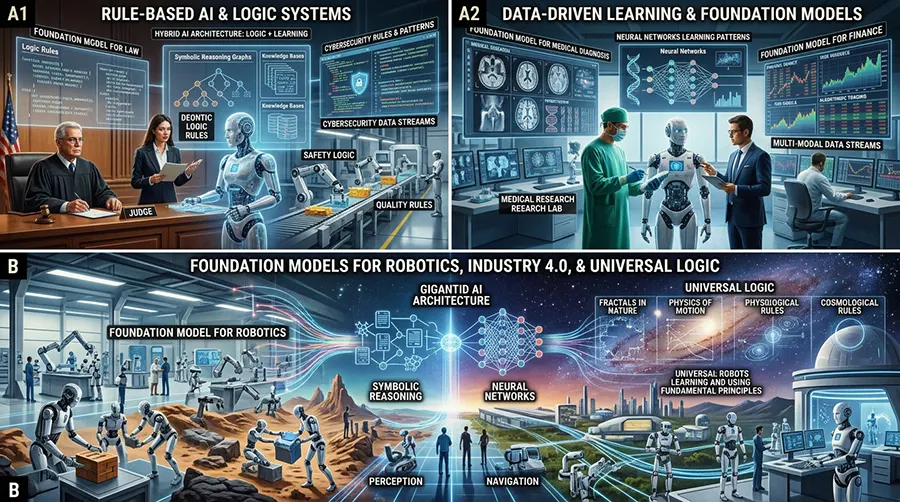
14.3. China: The Acceleration of Humanoid Robotics and Embodied AI
China is investing heavily in artificial intelligence and robotics.
Chinese companies are developing humanoid robots, vision systems, autonomous platforms and models designed to control physical machines.
Notable players include:
- Unitree Robotics.
- UBTECH Robotics.
- AgiBot.
- Fourier Intelligence.
- Xiaomi Robotics.
- XPeng Robotics.
One important development is the emergence of embodied AI.
This approach seeks to combine artificial intelligence models with physical agents capable of interacting directly with their environment.
The problem is particularly complex.
A language model may understand an instruction such as “pick up the red object and place it on the table”.
A robot, however, must translate this instruction into a sequence of physical operations:
- Identify the red object.
- Estimate its position.
- Calculate a trajectory.
- Position its arm.
- Adjust its gripping force.
- Grasp the object.
- Check its stability.
- Move it.
- Place the object down.
Each stage may require different information.
Embodied AI seeks precisely to bring the understanding capabilities of advanced models closer to the physical constraints of action.
Logic plays a role, in particular, in task decomposition, goal representation and the verification of certain execution conditions.
14.4. South Korea: Convergence Between Electronics, AI and Robotics
South Korea also has an environment particularly conducive to the development of intelligent robotics.
Its electronics industry, technological infrastructure and manufacturing capabilities are important contributing factors.
Several players contribute to this ecosystem:
- Hyundai Motor Group.
- Boston Dynamics.
- Samsung Electronics.
- Rainbow Robotics.
- LG Electronics.
Humanoid robotics and advanced manipulation systems represent particularly important development areas.
Industrial, logistics and assistive applications require architectures capable of combining situation recognition, planning and reliable execution.
Research into neuro-symbolic systems and multimodal models may contribute to this evolution.
14.5. Foundation Models for Robotics
One of the most important contemporary directions concerns foundation models applied to robotics.
These models seek to learn general-purpose representations from large quantities of multimodal data.
They can integrate:
- Images.
- Video sequences.
- Linguistic instructions.
- Trajectories.
- Robotic actions.
- Sensor information.
The objective is to produce systems capable of transferring certain skills from one task to another.
Vision-Language-Action (VLA) models, in particular, combine visual perception, linguistic understanding and action generation.
They represent an important direction in the development of more versatile robots.
However, understanding an instruction does not guarantee that its execution will be safe.
Physical constraints, safety rules and real operating conditions still require appropriate control and validation mechanisms.
14.6. Why Logic Remains Essential to Advanced Robotics
An intelligent robot cannot simply recognise shapes or predict plausible actions.
It must comply with constraints.
It must not enter a prohibited area.
It must not grasp an object when doing so could destroy it.
It must be able to interrupt an operation when conditions become dangerous.
These requirements correspond to problems involving verification, planning and decision-making.
Logic makes it possible to formalise some of these constraints.
Neural networks provide the ability to interpret complex sensory data.
Probabilistic methods make it possible to estimate uncertainty.
Control algorithms transform decisions into physical commands.
The future of intelligent robotics therefore depends to a large extent on the quality of the integration of these different components.
15. Practical Applications of Logic in Artificial Intelligence
15.1. Medicine and Diagnostic Decision-Support Systems
Diagnostic decision-support systems can make use of structured medical knowledge.
A hybrid architecture can combine:
- Clinical data.
- Statistical models.
- Medical rules.
- Ontologies.
- Reasoning systems.
- Uncertainty-management mechanisms.
A neural network can identify abnormalities in a medical image.
A symbolic system can then compare the information obtained with medical rules or knowledge.
This combination may improve the traceability of certain decisions, without replacing clinical validation or the judgement of healthcare professionals.
15.2. Cybersecurity
Logic also plays a role in computer security systems.
Access-control rules can be formalised as conditions.
Example:
A user may access a resource only if they possess the required permissions.
Detection systems can also combine explicit rules with machine learning models.
The former identify certain known signatures or violations.
The latter detect statistical anomalies.
This complementarity is important for improving the detection of suspicious behaviour.
15.3. Finance and Risk Analysis
Financial systems use logical rules to verify certain transactions.
They can, in particular, check:
- Transaction compliance.
- Contractual conditions.
- Risk limits.
- Authorisations.
- Regulatory obligations.
Statistical models can simultaneously estimate probabilities and identify anomalies.
Combining the two approaches makes it possible to bring together explicit compliance rules and data analysis.
15.4. Law and Intelligent Legal Systems
Legal reasoning is based on the interpretation of texts, the legal classification of facts and the application of rules.
Computer systems can represent certain legal standards as conditions and logical relationships.
Example:
- A rule applies to a category of persons.
- Certain conditions must be met.
- Exceptions may modify its application.
- A legal consequence may follow.
Deontic logic and knowledge-representation systems can help formalise these structures.
However, legal interpretation cannot be reduced to a logical calculation.
It also involves questions of context, the hierarchy of legal norms, interpretation and the assessment of facts.
15.5. Industry 4.0 and Predictive Maintenance
In industrial environments, intelligent systems can combine sensor data, technical rules and predictive models.
A system may, for example:
- Detect abnormal vibration.
- Estimate the probability of a failure.
- Identify the equipment concerned.
- Check operating conditions.
- Trigger a maintenance procedure.
Logic makes it possible to formalise certain intervention conditions.
Statistical models make it possible to estimate risks.
Control systems ensure that authorised operations are carried out.
This combination is an important component of industrial digital transformation.
16. The Scientific Challenges of Integrating Logic and AI
16.1. Knowledge Representation
One of the fundamental problems is transforming information from the real world into representations that a computer system can use.
Data is often incomplete, ambiguous or contradictory.
The same expression may have several meanings.
The same entity may be referred to in different ways.
Knowledge may also evolve over time.
Constructing coherent representations therefore requires appropriate modelling methods.
Ontologies, knowledge graphs and logical systems are important tools for addressing these difficulties.
16.2. Moving Between Numerical and Symbolic Representations
Neural networks work primarily with numerical representations.
Logical systems manipulate symbols and formal structures.
Moving from one representation to the other is far from straightforward.
A visual model may identify a shape without directly producing a reliable logical proposition.
A symbolic engine may manipulate a category without possessing the perceptual information needed to recognise the objects belonging to it.
Neuro-symbolic research specifically seeks to establish translation and interaction mechanisms between these two domains.
16.3. Managing Uncertainty
Classical logic operates with propositions whose truth conditions are defined.
However, intelligent systems often work with uncertain information.
An image may be difficult to interpret.
Information may be incomplete.
An observation may be contradictory.
A prediction may have a margin of error.
Probabilistic models and non-classical logics make it possible to study these situations.
One of the major challenges is to combine rigorous reasoning mechanisms with representations capable of handling uncertainty.
16.4. Explainability and Verifiability
The ability to explain a decision is a central issue in artificial intelligence.
A system may provide a linguistic explanation without that explanation constituting a formal proof of its result.
It is therefore important to distinguish between:
- An explanation produced in natural language.
- A justification based on explicit rules.
- A formal proof.
- The traceability of the data used.
- Empirical validation.
Neuro-symbolic architectures may help improve certain forms of explainability, but they do not automatically guarantee the reliability of the entire system.
16.5. Computational Complexity
A logical system may be theoretically capable of solving a problem without being able to do so within a reasonable amount of time.
Computational complexity is therefore an essential constraint.
The number of possible combinations can increase very rapidly as the size of a problem grows.
Search algorithms, heuristics, optimisation methods and specialised solvers make it possible to overcome certain difficulties.
The objective is to find a balance between the expressive power of the system and its operational efficiency.
16.6. Combining Expressive Power and Computational Efficiency
The development of intelligent systems requires compromises between the complexity of the representations used and the resources needed to process them.
A highly expressive logical language may make it possible to represent complex relationships, but it can also make reasoning more difficult.
Conversely, a restricted formalism may offer efficient algorithms while limiting the range of problems that can be represented.
The same challenge arises in neural architectures.
Increasing model size and computational resources does not necessarily guarantee better reasoning or greater reliability.
Research therefore seeks architectures capable of combining expressive representations, efficient algorithms and appropriate verification mechanisms.
17. Towards Artificial Intelligence Capable of Reasoning, Learning and Acting
17.1. The Evolution Towards Hybrid Architectures
The development of artificial intelligence shows that different approaches do not necessarily replace one another.
Formal logic, neural networks, probabilistic methods and search algorithms address different problems.
Contemporary architectures increasingly seek to combine them.
A hybrid architecture may include:
- A perception module.
- A language model.
- A knowledge base.
- A reasoning engine.
- A planner.
- A control system.
- A verification module.
This organisation makes it possible to distribute responsibilities among several specialised components.
The neural model can interpret a request.
The logical engine can formalise certain constraints.
The planner can search for a sequence of actions.
The control system can execute commands.
The verification module can examine whether the required conditions have been met.
17.2. Intelligent Agents
Intelligent agents represent another important development.
An agent can receive an objective, analyse a situation, select tools and execute several successive operations.
It is therefore no longer necessarily limited to producing a textual response.
It can interact with software, consult databases, manipulate information and trigger authorised actions.
This operational autonomy nevertheless requires control mechanisms.
Systems must be able to verify:
- The objectives being pursued.
- The permissions available.
- The conditions of execution.
- The foreseeable consequences.
- The results obtained.
Logic can help formalise these constraints.
However, it is not sufficient on its own to guarantee an agent’s safety: security mechanisms, technical controls and supervision remain essential.

17.3. Embodied AI and Reasoning in the Physical World
Embodied AI represents a particularly ambitious development.
It seeks to associate artificial cognitive capabilities with agents capable of interacting with the real world.
A system of this kind must connect:
- Perception.
- Understanding.
- Environmental representation.
- Planning.
- Decision-making.
- Action.
- Learning through feedback.
This approach goes beyond simple text generation.
It involves continuous interaction between computational models and the physical constraints of the environment.
Humanoid robots, autonomous vehicles, manipulation systems and advanced industrial platforms are particularly important areas of research.
17.4. Convergence Between Formal Reasoning and Learning
One of the most interesting scientific directions consists in directly integrating logical constraints into learning mechanisms.
A model can thus be trained while taking into account rules that restrict the admissible results.
Other architectures seek to transform symbolic knowledge into numerical representations that neural networks can exploit.
Some approaches also combine language models with theorem-proving engines or verification systems.
These developments aim to bring together three properties:
- Learning capabilities.
- Reasoning capabilities.
- The ability to provide justification.
A review study published in the IJCAI 2025 proceedings, devoted to neuro-symbolic artificial intelligence in the era of black-box models, highlights, in particular, the differences between systems whose rules effectively constrain their outputs and those that reconstruct an explanation after producing a prediction.
This distinction is essential to avoid confusing apparent explainability with genuinely controlled reasoning.
Source:
https://ijcai.org/proceedings/2025/1157
17.5. Medium- and Long-Term Scientific Prospects
Several research areas are likely to remain particularly important:
- Neuro-symbolic architectures.
- Multimodal foundation models.
- Probabilistic reasoning systems.
- Automated planning.
- Formal verification of agents.
- Proof assistants.
- Dynamic knowledge models.
- Embodied AI.
- Autonomous robotics.
- Multi-agent systems.
The challenge is not simply to produce increasingly large models.
It also involves building systems capable of combining learning, contextual understanding, verifiable reasoning and controlled action.
The quality of this integration could become one of the major criteria distinguishing artificial intelligence architectures.
18. How to Distinguish a Logical System, an Expert System, a Neural Network and an LLM
These categories are often grouped together under the general label of artificial intelligence, even though they are based on different principles.
| Technology | Core principle | Main function |
|---|---|---|
| Logical system | Manipulation of propositions and rules | Formal deduction |
| Expert system | Knowledge base and inference | Application of specialised rules |
| Neural network | Parameter learning | Recognition and prediction |
| Language model | Token prediction | Linguistic understanding and generation |
| Probabilistic model | Calculation of probability distributions | Management of uncertainty |
| Neuro-symbolic system | Combination of neural and symbolic approaches | Hybrid learning and reasoning |
| Intelligent agent | Coordination of several capabilities | Execution of complex tasks |
| Intelligent robot | Perception and action in the physical world | Autonomous interaction with the environment |
These distinctions help avoid a common misconception: not all artificial intelligence technologies reason in the same way.
A statistical model can recognise a situation without being able to formally demonstrate a conclusion.
A logical engine can establish a conclusion from rules without possessing autonomous learning capabilities.
A hybrid system seeks to combine these two properties.
19. Empirical Example: Building an Intelligent System Combining Logic and Learning
To understand the complementarity between these approaches in practical terms, let us consider the example of a mobile robot tasked with moving around a building.
The objective is to enable it to recognise obstacles, choose a route and comply with certain safety rules.
Step 1: Perceiving the Environment
The robot uses cameras and distance sensors.
A neural network analyses images to identify the objects present.
It can recognise, in particular:
- People.
- Doors.
- Furniture.
- Obstacles.
- Circulation areas.
The perception results are converted into structured information.
Step 2: Symbolic Representation
The detected objects are represented as facts.
Example:
Person(Zone_A).
Obstacle(Zone_B).
Door(Zone_C).
RestrictedArea(Zone_D).
This information constitutes a simplified representation of the environment.
Step 3: Formalising the Rules
The system incorporates safety rules.
IF restricted_area
THEN movement_prohibited.IF obstacle_detected
AND insufficient_distance
THEN stopping_mandatory.IF destination_accessible
AND route_safe
THEN movement_authorised.These rules can be translated into a formal language.
Step 4: Planning
The system examines the possible routes.
It searches for a route that reaches the destination while complying with the constraints.
A planner can use a pathfinding algorithm such as A*, combined with safety rules.
Step 5: Verification
Before executing an action, the system checks certain conditions.
Is the destination accessible?
Does the route cross a restricted area?
Has an obstacle been detected?
Is the speed compatible with the circulation conditions?
Formal constraints make it possible to check which actions are admissible.
Step 6: Execution and Feedback
The robot executes the command.
Its sensors then observe the consequences of the movement.
If the environment changes, the information is updated and the system can recalculate its route.
This example shows how different families of methods can be integrated into a single architecture.
The neural network interprets the environment.
Logic formalises certain rules.
The planner searches for a solution.
The control system executes the actions.
Together, they form a hybrid architecture combining perception, reasoning and action.
20. Conceptual Mistakes to Avoid When Discussing Logic and Artificial Intelligence
The media coverage of generative artificial intelligence has sometimes contributed to blurring the distinctions between several scientific concepts.
A few clarifications help place the issues in their proper context.
Logic is not synonymous with intelligence.
A logical system can perform rigorous deductions without possessing a general understanding of the world.
Learning is not proof.
A model can learn a statistical regularity without establishing that it constitutes a universal law.
A coherent answer is not necessarily true.
The linguistic quality of a response does not guarantee the validity of its content.
An explanation is not necessarily a proof.
A model can produce a convincing justification without having used a verifiable formal procedure.
Probability is not fuzzy logic.
These two approaches represent different forms of uncertainty or imprecision.
Autonomy is not synonymous with reliability.
An agent capable of executing several successive operations may also accumulate errors or make inappropriate decisions.
Robotics cannot be reduced to language understanding.
A robot must also perceive, localise, plan, control its movements and comply with physical constraints.
These distinctions make it possible to place contemporary advances within their proper scientific context.
21. Conclusion: Logic, a Lasting Foundation of Artificial Intelligence
The history of logic reveals a remarkable intellectual continuity.
From Aristotle’s earliest systems of reasoning to contemporary neuro-symbolic architectures, the discipline has progressively transformed the philosophical analysis of reasoning into a set of mathematical and computational tools.
The Stoics developed an in-depth analysis of propositions and inferences.
Medieval logicians enriched the study of consequences, meanings and linguistic structures.
Leibniz anticipated the possibility of a calculus of reasoning.
Boole gave logic an algebraic formulation.
Frege profoundly transformed the formal representation of propositions and relations.
Gödel, Church and Turing established essential results concerning the limits of formal systems and the possibilities of computation.
Computer science subsequently transformed these theoretical foundations into operational technologies: digital circuits, programming languages, inference engines, solvers and verification systems.
Artificial intelligence extended this development by introducing statistical learning methods capable of processing complex data and recognising patterns that are difficult to access through manual formalisation.
Today, the central question is no longer simply whether a machine can apply logical rules or learn from examples.
It is how these capabilities can be combined within architectures capable of interpreting their environment, mobilising knowledge, reasoning at several levels and acting reliably.
This issue is particularly visible in large language models, autonomous agents and intelligent robotics, notably within Asian technological ecosystems.
Neuro-symbolic research reflects this desire to bring together two traditions that have long been studied separately: formal reasoning and machine learning.
Logic is therefore neither an outdated technology nor an alternative to neural networks.
It remains an essential instrument for representing knowledge, formalising constraints, verifying reasoning and structuring decisions.
As artificial intelligence gradually moves beyond content generation into professional, industrial and physical environments, this requirement for rigour becomes even more important.
The next stage of AI will probably depend not only on its ability to produce increasingly convincing answers, but also on its capacity to establish verifiable conclusions, recognise its uncertainties and transform knowledge into actions that can be checked.
It is precisely at this intersection of logic, learning and action that one of the major scientific challenges of contemporary artificial intelligence lies.
22. Bibliography and Scientific Resources for Further Study of Logic and Artificial Intelligence
History and Foundations of Logic
- Aristotle – Organon: a collection of foundational texts on Aristotelian logic.
- Gottfried Wilhelm Leibniz – Stanford Encyclopedia of Philosophy: work on universal language and the calculus of reasoning.
- George Boole – The Mathematical Analysis of Logic: foundations of algebraic logic.
- Gottlob Frege – Stanford Encyclopedia of Philosophy: predicate logic and philosophy of language.
- Kurt Gödel – Stanford Encyclopedia of Philosophy: incompleteness theorems and the foundations of mathematics.
- Alan Turing – Stanford Encyclopedia of Philosophy: computability and the foundations of computer science.
Mathematical Logic and Theoretical Computer Science
- Stanford Encyclopedia of Philosophy – Classical Logic: principles and structures of classical logic.
- Stanford Encyclopedia of Philosophy – Modal Logic: modal systems and possible-world semantics.
- Stanford Encyclopedia of Philosophy – Intuitionistic Logic: intuitionistic logic and constructivism.
- Stanford Encyclopedia of Philosophy – Turing Machines: abstract models of computation.
- SAT Competition: competitions and developments in propositional solvers.
- SMT-LIB: reference standard for satisfiability modulo theories problems.
- Lean: an interactive theorem-proving environment.
- Coq: proof assistant and certified programming.
- Prolog: logic programming.
Neuro-Symbolic Artificial Intelligence
- Wang, Yang and Wu – Towards Data-And Knowledge-Driven AI: A Survey on Neuro-Symbolic Computing, IEEE TPAMI, 2025: scientific review of neuro-symbolic methods.
- DeLong, Fernandez Mir and Fleuriot – Neurosymbolic AI for Reasoning Over Knowledge Graphs, IEEE, 2025: reasoning over knowledge graphs.
- Marra et al. – From Statistical Relational to Neurosymbolic Artificial Intelligence: A Survey, Artificial Intelligence, 2024: convergence between logic, probabilistic models and learning.
- IJCAI 2025 – Neuro-Symbolic Artificial Intelligence: A Task-Directed Survey in the Black-Box Models Era: methods and limitations of neuro-symbolic architectures.
- IJCAI 2025 – Neuro-Symbolic Artificial Intelligence: Towards Improving the Reasoning Abilities of Large Language Models: integration of symbolic reasoning into language models.
- ZebraLogic – On the Scaling Limits of LLMs for Logical Reasoning, ICML 2025: experimental study of the logical reasoning capabilities of LLMs.
Contemporary Artificial Intelligence and Robotics
- Stanford HAI – AI Index Report 2026: developments in performance, reasoning, robotics and agentic systems.
- Stanford HAI – Technical Performance 2026: evaluation of the performance and limitations of artificial intelligence systems.
- International Federation of Robotics: international data and studies on industrial and service robotics.
- IEEE Robotics and Automation Society: research in robotics and automation.
- ROS – Robot Operating System: software environment for robot development.
- PDDL – Planning Domain Definition Language: formal representation of planning problems.
Additional Scientific References
- Turing, Alan M. (1936), On Computable Numbers, with an Application to the Entscheidungsproblem.
- Church, Alonzo (1936), An Unsolvable Problem of Elementary Number Theory.
- Russell, Bertrand and Whitehead, Alfred North (1910–1913), Principia Mathematica.
- Zadeh, Lotfi A. (1965), Fuzzy Sets, Information and Control.
- Vaswani et al. (2017), Attention Is All You Need.
- Wang, Yang and Wu (2025), Towards Data-And Knowledge-Driven AI: A Survey on Neuro-Symbolic Computing.
Primary SEO keywords: history of logic, definition of logic, mathematical logic, formal logic, logical principles, logical reasoning, artificial intelligence, logic and artificial intelligence, symbolic AI, neuro-symbolic AI, automated reasoning, computer logic, intelligent robotics.
Secondary SEO keywords: Aristotle, Leibniz, George Boole, Gottlob Frege, Kurt Gödel, Alan Turing, propositional logic, predicate logic, modal logic, fuzzy logic, probabilistic logic, logic programming, expert systems, inference engines, neural networks, large language models, generative AI, autonomous agents, embodied AI, humanoid robotics, machine learning, automated theorem proving.
Cet article est rédigé par Blaise Grenier, Journaliste reporter d'images et auteur. Découvrir le parcours de l'auteur et la charte éditoriale »