
Physical Foundations of Local Artificial Intelligence
The era of generative artificial intelligence has long suffered from a misconception: that of a digital immateriality suspended in remote cloud infrastructures. However, as the imperative for confidentiality, the pursuit of digital sovereignty, and the desire for immediacy redefine user requirements, the technological center of gravity is returning toward physical hardware. Running a Large Language Model (LLM) at the core of one’s own workstation is no longer merely an empirical experiment; it is an act of computer architecture demanding rigorous technical discipline regarding the laws of physics and electronics.
Selecting a hardware configuration dedicated to neural models requires moving beyond simplistic approaches focused solely on raw processing power. It is not the superficial metric of teraflops that dictates inference efficiency, but the technical fluidity of data throughput. Understanding these architectures requires recognizing that every generated word — every token — is the result of a massive data transfer across the system’s random-access memory circuits.
Metrics of Thought: Throughput, Latency, and Cognitive Ergonomics
To evaluate system suitability, technical analysis relies on a strict metric triad:
- Inference Throughput, measured in tokens per second (tok/s);
- TTFT (Time To First Token), reflecting initial prompt processing latency;
- Loading Latency, occurring between execution initiation and model activation.
Human perception operates within distinct biological boundaries. An experienced reader processes between 200 and 300 words per minute, corresponding to 3.5 to 5 words per second. Considering that one thousand tokens approximate 750 words, the threshold for comfortable reading lies between 4 and 6 tok/s for scanning, whereas a truly fluid reading experience develops above 10 to 15 tok/s. Below 1 tok/s, interactive engagement degrades into excessive delay that disrupts analytical flow.
By comparison, cloud infrastructures deliver elevated speeds (50 to 80 tok/s), albeit at the expense of erratic variability caused by shared server load. In a local environment, system consistency becomes a primary advantage, provided the hardware is sized with absolute precision.
Workload Hierarchy: From Efficiency to Monolithic Architectures
Empirical evaluation of contemporary architectures centers on rigorous benchmarks that test machine resilience against increasing textual complexity:
- Efficiency (Phi-4 Mini, 3.8B - January 2025): With a memory footprint ranging between 2.5 and 3.3 GB (Q4_K_M quantization), this model tests bus bandwidth limits and targets entry-level configurations with 8 GB of memory.
- Sprint (Llama 3.1, 8B - July 2024): Requiring 4.9 to 5.5 GB, it serves as the benchmark for daily fluid interaction across a vast majority of consumer GPUs.
- Endurance (Mistral Small 3, 22B - September 2024): Requiring 12 to 13 GB (Q4_0), it establishes a clear technical demarcation between 8 GB cards prone to memory saturation and 16 GB configurations with adequate headroom.
- The Wall (Llama 3.3, 70B - December 2024): Reduced to an aggressive Q2 quantization to fit within the 32 GB VRAM of a GeForce RTX 5090, it represents the upper operational limit of high-end consumer hardware.
- The Mountain (Command R+, 104B - April 2024): Demanding 59 to 61 GB, it remains the exclusive domain of unified memory configurations approaching or exceeding 128 GB.

Memory Bandwidth Dominance: Why VRAM Is Paramount
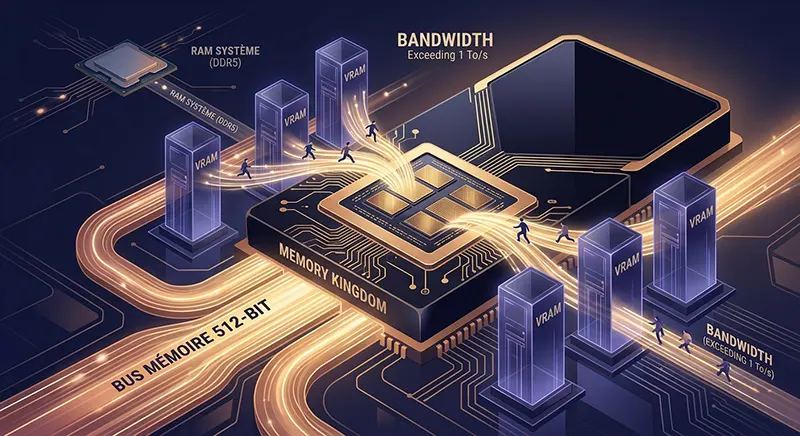
A common technical error involves prioritizing GPU core count while neglecting the underlying memory subsystem. The internal execution model of an LLM is uncompromising: for every generated token, the algorithm must read all model parameters. For an 8-billion-parameter model quantized in 4-bit precision, approximately 5 GB of data must transfer from memory to execution units for a single word. Maintaining a target speed of 100 tok/s requires a critical bandwidth of 500 GB per second.
This constraint defines the hardware hierarchy:
- High-End Dedicated GPUs: Utilizing ultra-fast GDDR7 memory and wide memory buses (up to 512-bit on the RTX 5090), these devices surpass 1 TB/s bandwidth, enabling throughputs above 150 tok/s.
- Unified Memory Architectures (Apple M4 Ultra, Nvidia GB10, AMD Strix Halo): By unifying high-capacity RAM adjacent to the processor, they achieve bandwidths ranging from 250 to 800 GB/s, bypassing traditional PCIe bottlenecks to execute massive models (70B) efficiently.
- Fallback to System RAM (GGUF on CPU): A restrictive alternative. Even paired with dual-channel DDR5 memory, bandwidth tops out between 50 and 100 GB/s. As soon as VRAM capacity is exceeded and layers offload to main system memory, performance drops sharply, significantly slowing interactions.
Software Ecosystem and Integration Constraints
Hardware architecture depends entirely on software abstraction layers. Nvidia’s historical market dominance stems not only from CUDA core performance, but from the maturity of its software stack. Conversely, integrating AMD hardware under Windows highlights the complexity of GPGPU compute layers: while ROCm requires specialized installation procedures, APIs like Vulkan frequently serve as viable alternatives for direct compute execution on non-Nvidia GPUs.
Furthermore, layer offloading (partially offloading neural layers to system RAM when VRAM saturates) illustrates the limitations of an under-provisioned system. Factoring in raw model size, context window memory requirements (KV Cache, which scales linearly with conversation length), and operating system overhead, available memory headroom diminishes rapidly.
Strategic Bifurcation: “Reflex” AI vs. “Brain” AI
A comparative analysis of these hardware configurations leads to a clear technical conclusion: hardware selection should be driven not by the pursuit of absolute speed, but by specific workload characteristics and analytical complexity requirements.
- “Reflex” AI (Lightweight Models 3B to 14B): Engineered for efficiency, these models emphasize rapid response times. Powered by modest configurations (8 to 12 GB VRAM), they deliver instant feedback, making them ideal for quick email processing, code analysis, or targeted document retrieval.
- “Brain” AI (Heavyweight Models 70B to 400B): This tier focuses on deep analytical reasoning, complex problem solving, and advanced document synthesis. Deployment requires substantial hardware resources — multi-GPU nodes or unified memory architectures — where processing volume supersedes raw generation speed. The system prioritizes computational depth over immediate latency.
In summary, designing a local artificial intelligence setup requires strict alignment between hardware specifications and operational demands. Raw compute power is insufficient without an adequate bus architecture; silicon cannot realize its full potential without high-performance memory subsystems.
The Local AI Revolution: Comparative Analysis of GMKtec Mini-PCs and Sovereign Inference Architectures
The natural language processing and generative AI landscape is undergoing a profound structural shift. The dominance of cloud-hosted architectures — burdened by recurring API costs, variable latencies, and data privacy concerns — is yielding to decentralized local infrastructure. Within this paradigm, compact systems such as GMKtec Mini-PCs condense datacenter-grade inference capabilities into low-power, compact form factors.
Rigorous hardware evaluation allows for a precise hierarchy of configurations, benchmarked against LLM inference requirements and continuous automated workloads.
Systemic Overview: Inference Hardware Mapping
The efficiency of a local AI system depends on the balance between CPU clock speeds, memory bandwidth, and integrated Neural Processing Unit (NPU) capabilities. GMKtec compact workstations fall into three distinct infrastructure tiers.
1. Sovereign “Ultra-Pro” Tier (Heavily Quantized & Giant LLM Inference)
These workstations represent state-of-the-art compact computing. Engineered for autonomous agent execution and models exceeding 70 billion parameters, they compete directly with traditional server setups.
| Model Reference | CPU Architecture & Cores | Unified Memory & Bandwidth | Inference Capabilities & Target Models |
|---|---|---|---|
| GMKtec EVO-X2 | AMD Ryzen™ AI Max+ 395 (16C / 32T, TSMC 4nm, 5.1 GHz, TDP 120W-140W) | 64 GB or 128 GB LPDDR5X (8000/8533 MHz, 8 channels) | Local inference benchmark. 126 global TOPS, XDNA 2 NPU. Runs DeepSeek-R1 (70B), Llama 4 (109B), and Qwen3 (235B) with optimal stability. |
| GMKtec EVO-X3 | AMD Ryzen™ AI Max+ 395 (16C / 32T, Zen 5 architecture) | 128 GB LPDDR5X (8000 MT/s) & Dual M.2 PCIe 4.0 | Engineered for persistent data workloads. High-throughput inference and support for multi-terabyte local vector databases. |
| Intel EVO-T1 / T2 Series | Intel Core Ultra X9 / Ultra 9 285H (16 cores, up to 180 global TOPS) | 64 GB LPDDR5X, Integrated Arc B390 Graphics | Optimized integration with OpenVINO frameworks. Ideal for multimodal analysis and computer vision processing. |

2. Prosumer and Intermediate Tier (Data Processing & Media Inference)
This tier provides an optimal cost-to-performance ratio, capable of hosting intermediate-sized models while handling demanding application tasks such as audio production, video editing, and semantic analysis.
| Model Reference | CPU Architecture & Cores | Memory & Expandability | Inference Capabilities & Target Models |
|---|---|---|---|
| GMKtec EVO-X1 | AMD Ryzen™ AI 9 HX 370 (12C / 24T, Zen 5) | 32 GB LPDDR5X (7500 MHz), OCuLink Port | Low-latency inference for 14B to 32B models. Expandable via external GPU through OCuLink. |
| NucBox K11 | AMD Ryzen 9 8945HS (8C / 16T) | Expandable DDR5 Architecture | Optimized for parallel processing, high-speed scraping, and document vectorization. |
| NucBox K8 Plus / K6 / K12 | AMD Ryzen 7 8845HS / 7840HS (8C / 16T) | 32 GB DDR5 RAM, Multi-slot M.2 Architecture | Operational efficiency. Radeon 780M graphics, strong thermal management, and low noise levels. |
| NucBox K10 | Intel Core i9-13900HK (14 cores / 20 threads) | Expandable DDR5 Architecture | High single-threaded and multi-threaded performance, suited for continuous AI agent execution. |
3. Operational Entry Tier (Continuous Automation & Lightweight Models)
Designed for smaller application environments, these setups manage continuous data collection, filtering pipelines, and basic semantic analysis.
| Model Reference | CPU Architecture & Cores | Memory & Storage Setup | Inference Capabilities & Target Models |
|---|---|---|---|
| K13 | Intel Core Ultra 7 256V | Integrated, High Energy Efficiency | Suitable for filtering tasks, metadata generation, and running 7B parameter models. |
| NucBox M3 Ultra | Intel Core i7-12700H (14 cores / 20 threads) | 32 GB DDR4 / Dual M.2 Slots + 2.5" SATA | Hardware versatility. Native support for 2.5-inch SATA drives for cost-effective bulk data storage. |
| M7 Ultra | AMD Ryzen™ 7 PRO 6850U (8C / 16T) | 32 GB DDR5 / PCIe 3.0 SSD | Enterprise-grade stability and low power draw for quiet 24/7 continuous operation. |
Technical Focus: GMKtec EVO-X2 Inference Workstation
Detailed analysis of the GMKtec EVO-X2 highlights the advances achieved through high-density System-on-Chip (SoC) architectures. The AMD Ryzen™ AI Max+ 395 processor, manufactured on TSMC’s 4nm process, pairs 16 physical cores with a Radeon 8060S GPU based on the RDNA 3.5 architecture.
+-----------------------------------------------------------------------+
|                         GMKtec EVO-X2 ARCHITECTURE                    |
|                                                                       |
|  +-----------------------------------------------------------------+  |
|  | AMD Ryzen AI Max+ 395 (16 Cores / 32 Threads - Zen 5)           |  |
|  +-----------------------------------------------------------------+  |
|  | NPU XDNA 2 (50 TOPS)  |  GPU Radeon 8060S (40 CUs RDNA 3.5)     |  |
|  +-----------------------+-----------------------------------------+  |
|                                                                       |
|  +-----------------------------------------------------------------+  |
|  | Unified LPDDR5X-8533 Memory Bus (8 Channels - Up to 128 GB)       |  |
|  +-----------------------------------------------------------------+  |
|                                                                       |
|  +-----------------------------------------------------------------+  |
|  | NVMe PCIe 4.0 x4 Storage (2x M.2 Slots - Up to 16 TB)             |  |
|  +-----------------------------------------------------------------+  |
+-----------------------------------------------------------------------+
Detailed System Specifications of the GMKtec EVO-X2
- Central Processing Unit (CPU): AMD Ryzen™ AI Max+ 395, 16 cores, 32 threads, 5.1 GHz boost clock, 80 MB combined cache (L2+L3), configurable TDP from 45W to 140W.
- Graphics Processing Unit (GPU): AMD Radeon™ 8060S, 40 Compute Units (CUs) on RDNA 3.5 architecture, providing high-performance compute and graphics capabilities.
- Neural Processing Unit (NPU): AMD XDNA 2 architecture delivering 50 dedicated TOPS, pushing overall system capacity to 126 TOPS.
- Memory Subsystem: Up to 128 GB LPDDR5X RAM operating at 8533 MHz across an 8-channel bus, delivering high bandwidth for model loading.
- Secondary Storage: Dual M.2 2280 NVMe PCIe 4.0 x4 slots, supporting up to 16 TB total capacity.
- Network & I/O Connectivity: Wi-Fi 7 (RZ717), Bluetooth 5.4, 2.5 Gigabit Ethernet (Realtek 8125BG), USB4 Type-C (40 Gbps), HDMI 2.1, and DisplayPort 1.4.
Local Inference Performance Metrics
LLM execution performance is primarily evaluated by Time to First Token (TTFT) latency and sustained generation throughput in tokens per second (t/s). Benchmarks conducted on the GMKtec EVO-X2 (128 GB LPDDR5X) confirm the viability of local inference for large models.
Observed Inference Benchmarks on EVO-X2 (128 GB)
- Qwen3 (235B Parameters): TTFT of 0.03 s, average speed of 11.00 t/s.
- Llama 4 (109B-Q4KM): TTFT of 0.02 s, average speed of 13.83 t/s.
- OpenAI GPT-OSS (120B): TTFT of 0.53 s, average speed of 19.25 t/s.
- Qwen3 (30B): TTFT of 0.18 s, average speed of 55.02 t/s.
- DeepSeek-R1 (32B): TTFT of 10.50 s, average speed of 9.26 t/s.
Infrastructure Optimization for SEO & Media Automation
Integrating a GMKtec Mini-PC into a digital content pipeline enables a continuous automation architecture at minimal operating costs.
+-----------------------------------------------------------------------+
|                    LOCAL INFRASTRUCTURE AUTOMATION                    |
|                                                                       |
|  [Step 1: 24/7 Data Collection & Scraping]                            |
|         |---> Python / Playwright Scripts (Multi-threaded execution)  |
|         v                                                             |
|  [Step 2: Semantic Orchestration]                                     |
|         |---> n8n Platform (Automated local workflows)                |
|         v                                                             |
|  [Step 3: Local AI Inference & Synthesis]                             |
|         |---> Ollama / LM Studio (DeepSeek, Qwen, Llama models)       |
|         v                                                             |
|  [Step 4: Deployment & SEO Indexing]                                  |
|         |---> API Publishing & Unique Image Generation                |
+-----------------------------------------------------------------------+
Core Benefits for Content Productivity
- Elimination of API Expenses: Running semantic models locally removes per-token API charges, accelerating hardware return on investment.
- Continuous Scraping and Processing: High-efficiency CPU cores manage data collection, competitor monitoring, and parsing without degrading main system performance.
- Data Sovereignty and Privacy: Keeping processing on-premise protects internal knowledge bases, proprietary data, and content strategies prior to publication.
- Energy Efficiency: Consuming between 15W and 45W under typical workloads, operational electricity costs remain significantly lower than traditional rack servers.
In summary, the GMKtec Mini-PC lineup provides practical hardware solutions for modern compute requirements. From versatile daily drivers like the M3 Ultra or K8 Plus to high-capacity inference systems like the EVO-X2, these devices offer a robust foundation for self-hosted AI infrastructure.
Cet article est rédigé par Blaise Grenier, Journaliste reporter d'images et auteur. Découvrir le parcours de l'auteur et la charte éditoriale »