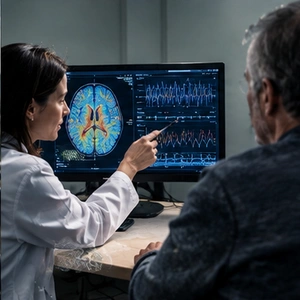
1. The Operational Mutation: From Aid to Diagnosis to Personalized Medicine
Artificial intelligence is transforming medical diagnostics by enhancing precision in imaging and genomic analysis while automating hospital workflow management. However, this structural shift raises major ethical challenges regarding algorithmic transparency and the sovereignty of human clinical decision-making.
The introduction of artificial intelligence at the heart of medical sciences is no longer a mere technological prospect, but a structural mutation of care practices. From the optimization of hospital workflows to precise genomic analysis, algorithms permeate the entire therapeutic chain. Yet, as machines gain diagnostic acuity, the entire healthcare system is confronted with a fundamental paradox: reconciling the infinite power of probabilistic computation with the ethical imperative of human responsibility.
The empirical examination of this transition reveals that artificial intelligence does not replace the clinician; it redefines the boundaries of their expertise by absorbing administrative complexity and refining the interpretation of weak signals.
The historical trajectory of medical computing, moving from early expert systems to contemporary neural network architectures, has profoundly transformed the nature of clinical care. The integration of these technologies now touches a diverse range of healthcare practice layers.
- Diagnostic Excellence: In fields requiring instant visual and textual acuity, such as medical imaging or structural cardiology, multimodal models sometimes outperform human vigilance, significantly reducing analysis times.
- Genomic Precision : The decoding of complex DNA mutations now relies on data analysis platforms that can guide targeted therapies, particularly in oncology and for rare diseases.
- Lightening the Administrative Burden: Automating meeting notes through specialized conversational assistants frees up valuable time for healthcare staff, refocusing the relationship on listening to the patient.
2. The Foundational Pillars of the Digital Health Ecosystem
The architecture of clinical applications is based on a diversification of algorithmic approaches, the implementation of which requires absolute methodological rigor.
+-----------------------------------------------------------------------+
|                 TYPOLOGIE DES USAGES CLINIQUES DE L'IA                |
+-----------------------------------------------------------------------+
| 1. PRÉVENTION & PRÉDICTION : Anticipation des urgences et des crises  |
| 2. ASSISTANCE PRESCRIPTIVE : Contextualisation et sécurisation des posologies|
| 3. CHIRURGIE AUGMENTÉE     : Guidage robotisé et précision géométrique|
| 4. SANTÉ MENTALE           : Suivi comportemental et écoute précoce   |
+-----------------------------------------------------------------------+
Predictive Medicine and Risk Anticipation
The use of deep learning models allows for anticipating the evolution of acute pathologies or monitoring weak signals in real time. Whether it be assessing the risks of cardiovascular accidents or adjusting therapeutic protocols in obstetrics, the machine offers a previously unseen horizon of anticipation.
The Securing of the Prescription
The integration of context-aware decision support tools allows for the cross-referencing of patient records with global pharmacological databases, drastically reducing the risks of harmful drug interactions and guiding the practitioner towards informed therapeutic choices.
3. Ethical, Environmental Issues, and Human Guarantees
Despite occasionally troubling clinical performances – with recent reasoning models now matching human expertise in emergency scenarios – the deployment of these technologies raises major systemic questions.
- Opacity of Models: The complexity of deep neural networks requires increased transparency to avoid the “black box” effect and protect medical decisions from algorithmic biases.
- The Sovereignty of Decision : In Europe, the principle of the ‘human guarantee’ enshrines the prohibition of total automation of diagnosis, reaffirming the indefectible responsibility of the healthcare professional.
- The Ecological Footprint: The energy cost of the computing infrastructure hosting these models directly contradicts the principles of ecological planning and sanitary sobriety.
Conclusion: Towards Shared Sovereignty
Artificial intelligence in medicine does not paint a picture of a sterile technological future, but one of a delicate co-evolution between the analytical power of the machine and the sovereign empathy of the caregiver. The success of this transition will depend on our ability to keep the human at the centre of therapeutic decision-making, ensuring a medicine that is both effective, just, and profoundly ethical.
Cet article est rédigé par Blaise Grenier, Journaliste reporter d'images et auteur. Découvrir le parcours de l'auteur et la charte éditoriale »